How to Organize the Perfect At-Home Manicure: Choosing a Nail Drill, Tools, and Step-by-Step Instructions for Beginners
At-Home Manicure: Why It's Cost-Effective and Convenient
At-home manicures have long ceased to be a compromise between quality and savings. Today, with the right tools and basic knowledge, you can create salon-quality manicures without leaving your home. This not only saves time and money but also allows you to experiment with designs in a comfortable setting, whenever it's convenient for you.
Professional at-home manicures require a certain set of tools and skills. The key is understanding the basic principles of nail care, properly selecting equipment, and following safety techniques. In this article, we'll examine in detail what you need to organize a home manicure space and how to properly perform all stages of the procedure.
Essential Tools for At-Home Manicure
Quality manicures are impossible without the right set of tools. A basic kit includes several essential elements that will ensure professional results.
Nail Drill – The Heart of Your Home Salon
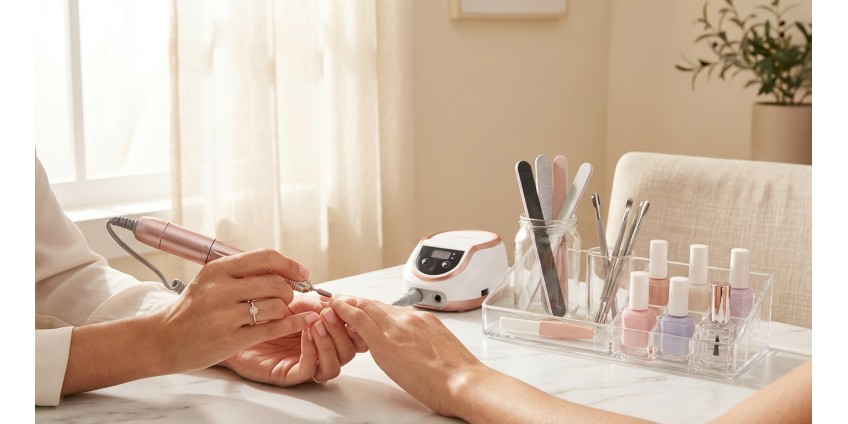
E-file manicures have become the gold standard in nail care. A nail drill allows you to quickly and safely work on cuticles, buff the nail plate, remove old coatings, and perform pedicures. For home use, a compact model with 35-65W power and speed adjustment from 0 to 35,000 RPM is suitable.
When choosing a nail drill, pay attention to the ergonomics of the handpiece – it should fit comfortably in your hand, as the procedure can last 30-60 minutes. Also important is the presence of reverse (direction change) and smooth speed control. For beginners, it's recommended to start with low speeds – 10,000-15,000 RPM.
Manicure Sets and Individual Tools
Besides a nail drill, you'll need a basic set of manual tools. Quality manicure sets typically include a cuticle pusher, scissors, nippers, files of varying grits, and a buffer for polishing.
Choose tools made from medical-grade or stainless steel – they're durable, easy to disinfect, and don't rust. Pay special attention to nippers – they should be well-sharpened to cut cuticles in one motion without leaving hangnails. Quality nippers don't pull the skin but cut it cleanly.
Nail Drill Bits
For e-file manicures, you need a set of bits for different purposes. A basic kit includes:
- Ceramic bits – for removing gel polish and working on the nail plate
- Diamond bits – for working on cuticles and sidewalls
- Ball or cone – for lifting and opening cuticles
- Cylinder or barrel – for working on sidewalls
- Needle or flame – for cleaning the sinuses
For beginners, it's recommended to use medium-grit bits (blue or red band), which are less traumatic. Over time, as your hand becomes more skilled, you can move to coarser bits.
Organizing Your Workspace
A comfortable and functional workspace is the key to quality manicures. You'll need a table with good lighting, a comfortable chair, a manicure hand pillow, and an organizer for tools.
Lighting and Cleanliness
Proper lighting is critically important for precise work. An LED lamp with cool white light is ideal, as it doesn't distort colors and doesn't create shadows. Position the lamp so light falls directly on your hands.
Maintain workspace cleanliness. Regularly wipe surfaces with disinfecting products, store tools in a closed organizer. After each use, tools need to be cleaned with special solutions or sterilized.
To maintain order in your workspace, it's useful to have a storage system. For example, organizers for small items will help systematize bits, files, and other small accessories so everything you need is always at hand.
Step-by-Step Instructions: Perfect At-Home Manicure
Now that you have all the necessary tools, let's look at the detailed process of performing a manicure from preparation to final coating.
Step 1: Nail Preparation
Start by removing old polish. If it's regular polish, use nail polish remover. For gel polish, you'll need a nail drill with a ceramic bit or special removal solution.
Next, decide on your nail shape. Using a file with 180-240 grit, give your nails the desired shape – square, oval, almond, or coffin. File in one direction to avoid splitting the nail plate.
Step 2: Working on Cuticles
Apply a special cuticle remover or softening oil to the cuticles. Leave for 3-5 minutes to soften. This will make further processing easier and make the process less traumatic.
If you're using the e-file method, turn on the drill at low speed (10,000-15,000 RPM). With a diamond ball bit, gently lift the cuticle, moving from the sides to the center. Then with a cone or cylinder bit, clean dead skin from the nail plate.
For classic cut manicures, use a pusher to push back the cuticle, then carefully trim it with nippers. Move smoothly without lifting the tool from the skin to avoid hangnails.
Step 3: Working on Sidewalls and Sinuses
With a barrel or cylinder bit, work on the sidewalls, removing rough skin. Move from the base of the nail to the free edge. For cleaning the sinuses (where the nail meets the sidewall), use a thin needle or flame bit.
Be especially careful in these areas – the skin here is thin and sensitive. Work without pressure, with light touches, letting the bit do its work.
Step 4: Buffing and Polishing
With a buffer or soft file, lightly buff the nail plate, removing irregularities. This will improve adhesion with the coating. Don't overdo it – 2-3 light strokes per nail are sufficient.
Remove dust with a brush or lint-free wipe moistened with dehydrator. This will prepare the nails for coating application.
Step 5: Applying Polish
If you're doing a gel polish manicure, the sequence is:
- Apply primer or acid-free bonder for better adhesion
- Cover nails with a thin layer of base coat, cap the free edge. Cure in the lamp
- Apply colored gel polish in 1-2 layers, curing each in the lamp
- Cover with top coat, cap the free edge, cure
- Remove the sticky layer if the top coat isn't no-wipe
For regular polish, the sequence is simpler: base coat, 1-2 layers of color, top coat.
Step 6: Final Care
Apply nourishing oil to the cuticles and give your fingers a light massage. This will moisturize the skin, speed healing of micro-traumas, and give your hands a well-groomed appearance.
Tool Care
Proper care of manicure tools extends their lifespan and ensures procedure hygiene.
After each use, clean tools of skin residue, polish, and dust. Metal tools can be immersed in disinfecting solution for 15-30 minutes, then rinsed and dried. Clean bits with a special brush and also disinfect.
For sterilization at home, you can use a dry heat sterilizer, autoclave, or UV sterilizer. Store clean tools in a closed container, protecting them from dust and dirt.
Maintaining cleanliness is important not only for tools but for the entire workspace. Regularly wipe work surfaces – cleaning wipes are perfect for this, effectively removing dust and cosmetic product residue.
Common Beginner Mistakes
Even with detailed instructions, it's easy to make mistakes. Here are the most common ones:
- Excessive pressure when working with the nail drill – the bit should glide over the surface, not be pressed into it. Pressure creates heat and can damage the nail plate
- Too high speed for beginners – start at 10,000-15,000 RPM, gradually increasing speed as you gain experience
- Working against the direction of cuticle growth – always move from the sides to the center, following the natural shape
- Skipping preparatory steps – dehydrator, primer, and base aren't unnecessary steps, they ensure coating longevity
- Thick layers of gel polish – it's better to apply two thin layers than one thick one, which may not cure properly or peel
Savings and Benefits of At-Home Manicure
Initial investment in tools may seem significant, but it pays off quickly. The average cost of a salon manicure is 300-500 UAH, with regularity every 2-3 weeks that's 6,000-10,000 UAH per year. A quality tool set costs 3,000-5,000 UAH and lasts for years.
Besides savings, at-home manicures give you creative freedom, the ability to do the procedure at a convenient time, and confidence in tool sterility. You can experiment with designs without worrying about the additional cost of complex artwork.
Conclusion: Your Path to Perfect At-Home Manicure
Organizing a home manicure space is an investment in the beauty and health of your nails. Start with a basic tool set: a quality nail drill with a set of bits, manual tools for classic manicure, and a disinfection system. Set up a comfortable workspace with good lighting.
Follow the step-by-step manicure technique: nail preparation, cuticle work, sidewall processing, buffing, coating application, and final care. Don't rush, especially at the beginning – quality is more important than speed. With practice, you'll develop skills, and the procedure will take less and less time.
Remember safety: don't press on the drill, work at moderate speeds, regularly disinfect tools. If pain or discomfort appears, stop – manicures should be a pleasant procedure, not an ordeal.
With the right tools, knowledge, and practice, you'll be able to create salon-quality manicures at home, saving time and money, enjoying the creative process, and having well-groomed, beautiful nails every day.
Products related to this post

₴198 грн. ₴245 грн.
Add to Cart
₴89 грн. ₴184 грн.
Add to Cart
₴5,999 грн. ₴9,499 грн.
Add to Cart