How to Choose a Smartwatch in 2026: Comparing Features, Battery Life, and Compatibility for Sports, Health, and Everyday Use
Smartwatches have long ceased to be just a fashionable accessory—today they are a full-fledged assistant for health monitoring, physical activity tracking, and managing everyday tasks. In 2026, the wearable gadget market offers a huge selection of models with different functionality, price categories, and capabilities. Let's figure out what to pay attention to when choosing a smartwatch to get the maximum benefit from this device.
Key Features of Modern Smartwatches
Before choosing a specific model, it's important to determine which features you actually need. Modern smartwatches can perform dozens of different tasks, but not all of them will be useful specifically for you.
Health Monitoring
One of the most popular features is health metrics tracking. Most modern models can measure heart rate in real-time, track sleep quality, blood oxygen levels (SpO2), and even perform ECG. Some models can warn about irregular heart rhythm, which is especially important for people with cardiovascular diseases.
For those who take their health seriously, it's worth paying attention to the presence of stress sensors, menstrual cycle monitoring in women's models, and the ability to track activity levels throughout the day. The reminder function to move after prolonged sitting will help maintain an active lifestyle even in the office.
Sports Features
For athletes and active lifestyle enthusiasts, sports modes are critically important. Modern smartwatches support from 10 to 100+ different types of workouts—from running and swimming to yoga and rock climbing. Built-in GPS allows you to accurately track running and cycling routes without the need to take your smartphone with you.
Important parameters for athletes also include water resistance (WR50 or 5ATM is desirable for swimming), the ability to connect external sensors (heart rate monitors, cadence), training load analysis, and recovery time recommendations. Some models even offer personalized training plans.
Everyday Features
Besides health and sports, a smartwatch can significantly simplify everyday life. Notifications about calls, messages, and calendar events allow you to not take your phone out of your pocket every five minutes. The ability to respond to messages directly from the watch (by voice or quick replies) is especially convenient in situations when your hands are busy.
Additional features include music control, contactless payments (NFC), voice assistant, alarms, and timers. For those who travel frequently, the automatic time zone detection function and the ability to store boarding passes or electronic tickets will be useful.
Battery Life: How Long Should a Watch Work Without Charging
Battery life is one of the most important parameters when choosing a smartwatch. There's nothing worse than a device that needs to be charged daily or even more often.
Modern smartwatches can be conditionally divided into three categories by battery life:
- 1-2 days—usually models with bright AMOLED displays and extensive functionality. Suitable for those who are ready to charge the watch every night, like a smartphone.
- 5-7 days—the golden mean. Such models offer a balance between functionality and battery life. Usually have less energy-consuming displays or power-saving modes.
- 2-4 weeks—fitness trackers and specialized sports watches with monochrome or semi-transflective displays. Ideal for long hikes and expeditions.
It's worth remembering that the battery life stated by the manufacturer is usually indicated for a mode with minimal use of features. Active use of GPS, constant heart rate monitoring, display brightness at maximum, and a large number of notifications can reduce operating time by half or even three times.
Compatibility with Smartphones and Ecosystems
Before purchasing, be sure to make sure that the chosen smartwatch is compatible with your smartphone. Most models work with both iOS and Android, but some features may be limited.
For iPhone Users
If you use an iPhone, the best integration will, of course, be with Apple Watch. However, many third-party manufacturers also offer good compatibility with iOS through apps in the App Store. It's worth paying attention to which features will be available: some models don't allow responding to messages from iPhone due to iOS limitations.
For Android Users
Android smartphone owners have a much larger selection. Watches on Wear OS from Google offer the deepest integration, access to Google Play, and the ability to install third-party apps. Alternative operating systems (manufacturers' proprietary developments) often work faster and consume less power, but have a limited set of apps.
If you have other smart devices at home, it's worth paying attention to ecosystem compatibility. Some smartwatches can control smart lighting, thermostats, or even routers through integration with smart home systems.
Design and Wearing Comfort
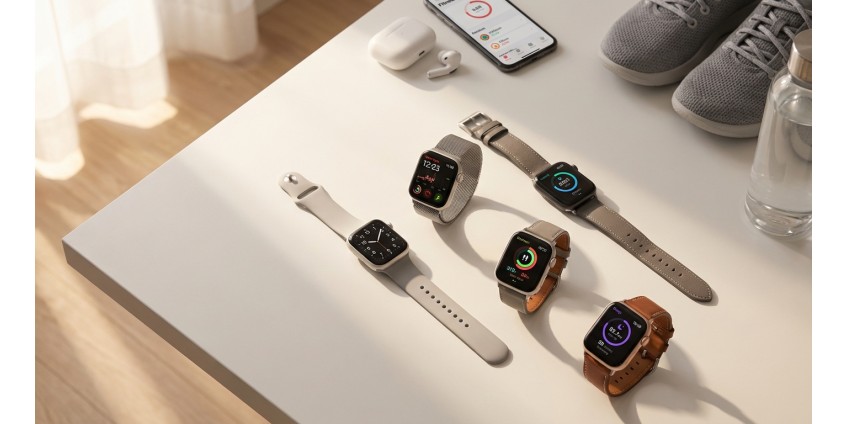
A smartwatch is an accessory that you'll wear all day, so comfort is extremely important. Pay attention to the device's weight (optimally up to 50-60 grams), case and strap material, size, and shape.
Round displays look more classic and are suitable for office dress code, square or rectangular ones are more functional as they allow more information to be placed on the screen. Screen size usually ranges from 1.1 to 1.9 inches—choose depending on your wrist size.
Strap material is also important: silicone is suitable for sports, leather for the office, metal or stainless steel for premium models. Many manufacturers offer interchangeable straps, which allows you to adapt the watch's appearance to different situations.
Additional Accessories and Expansion Possibilities
Besides the watch itself, it's worth thinking about additional accessories. Protective films or glass will help protect the display from scratches, additional straps will allow you to change styles, and portable charging stations will come in handy during travels.
Some smartwatches support Qi standard wireless charging, which allows you to use universal chargers. This is especially convenient if you already have charging devices for other gadgets.
Price Range and Value for Money
Smartwatches can be found in any price range—from budget models for 1000-2000 hryvnias to premium ones for 20,000 and more. Budget options usually offer basic functionality: step counting, sleep monitoring, notifications. Mid-range models (3000-8000 UAH) add GPS, water resistance, more sports modes, and better battery life.
Premium models are distinguished by the use of quality materials (titanium, sapphire glass), extended functionality (ECG, blood pressure measurement, LTE for working without a smartphone), and prestigious brand. For most users, the optimal choice will be a mid-price segment model that offers the best balance of functionality and price.
What Else to Pay Attention to When Choosing
Besides the main characteristics, there are several less obvious but important points. First, check for software updates—manufacturers who regularly release updates add new features and fix bugs. Second, look at real user reviews—they often talk about problems that aren't visible in technical specifications.
It's also worth paying attention to the quality of the mobile app through which data synchronization occurs. A convenient, informative app with the ability to analyze statistics in detail significantly increases the value of a smartwatch. Some manufacturers offer integration with third-party fitness platforms (Strava, Google Fit, Apple Health), which allows you to store all data in one place.
Don't forget about warranty and service. Official suppliers usually provide a warranty from 1 to 2 years, as well as the possibility of repair in authorized service centers. This is especially important for expensive models.
Conclusion: How to Make the Right Choice
Choosing a smartwatch in 2026 is a balance between functionality, battery life, design, and price. Before purchasing, clearly define your priorities: if you're an athlete—look for a model with GPS and long battery life, if you value health—choose a watch with extended medical metrics monitoring, if you need a stylish accessory for the office—pay attention to design and contactless payment capabilities.
Don't chase the most expensive model—often mid-budget options offer 90% of the functionality at half the price. Be sure to check compatibility with your smartphone, read real user reviews, and, if possible, try the watch on your wrist before buying—wearing comfort is no less important than technical specifications.
A modern smartwatch can become a real assistant in maintaining a healthy lifestyle, achieving sports goals, and optimizing everyday tasks. The main thing is to choose a model that matches your needs and lifestyle. On the GadgetGuys website, you'll find a wide range of wearable gadgets and accessories for phones and tablets that will help create the perfect ecosystem of your devices.
Products related to this post
₴79 грн.
Add to Cart
₴5,999 грн. ₴9,499 грн.
Add to Cart