
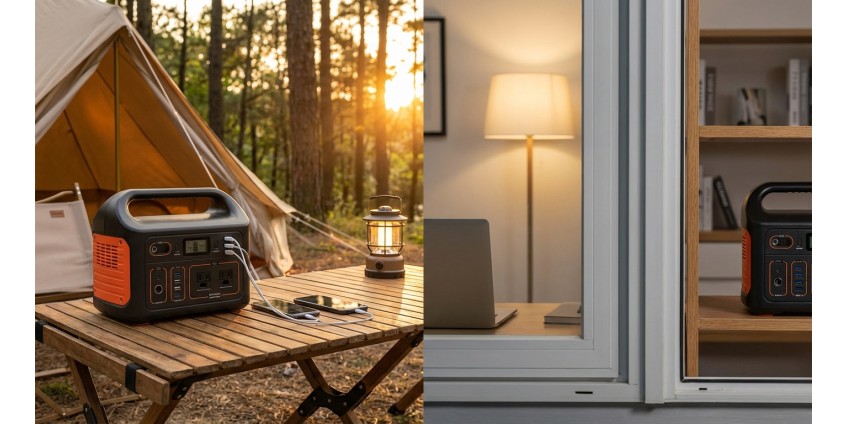
Portable Power Stations for Home and Camping: How to Choose an Alternative Power Source in 2026
Why Portable Power Stations Have Become a Necessity in Ukraine
Recent years have fundamentally changed our attitude toward power autonomy. Power outages, unstable electrical grid operation, and an active lifestyle have made portable power stations not a luxury, but an essential household item. These versatile devices can provide electricity both at home during blackouts and outdoors while camping or traveling.
A portable power station is essentially a powerful battery with various outputs for connecting household appliances, gadgets, and other equipment. Unlike regular power banks, such stations have significantly greater capacity (from 200 Wh to several kWh) and can power not only smartphones, but also laptops, refrigerators, power tools, and even medical equipment.
Key Characteristics When Choosing a Power Station
Battery Capacity
Capacity is the first parameter you should pay attention to. It's measured in watt-hours (Wh) or ampere-hours (Ah) and determines how much energy the station can store. For reference: a 500 Wh station can charge a smartphone (15 Wh) about 30 times, or power a laptop (50 W) for 10 hours.
For home use during short power outages, models with 300-500 Wh are sufficient. However, if you're planning extended outdoor trips or need backup power for important equipment, you should consider stations from 1000 Wh and above.
Inverter Power
Inverter power determines which appliances you can connect to the station. It's measured in watts (W) and must match the total power consumption of connected devices. For example, running a laptop, router, and charging phones requires 200-300 W. Connecting a mini-fridge, electric kettle, or power tools requires stations with 1000-2000 W.
It's important to consider peak power—some appliances (especially those with electric motors) consume 2-3 times more energy during startup than during operation.
Types and Number of Outputs
Modern power stations are equipped with various ports:
- USB-A and USB-C — for charging smartphones, tablets, headphones, and other gadgets
- AC outlets 220V — for household appliances, laptops, lighting
- 12V car cigarette lighter — for car accessories and equipment
- DC outputs — for specialized equipment
The more diverse ports a station has, the more versatile it will be in use. Pay attention to the presence of USB-C Power Delivery fast charging ports—they allow you to charge modern laptops and smartphones at maximum speed.
Ways to Recharge Portable Stations
Most modern power stations support several energy replenishment methods, making them maximally versatile:
From the Power Grid
The fastest charging method is from a regular 220V outlet. Depending on the model and charger power, a full charge can take from 2 to 8 hours. Some premium models support fast charging and can restore 80% capacity in 1-1.5 hours.
From Solar Panels
An eco-friendly and autonomous charging method, ideal for extended hikes and camping. This requires portable solar panels of appropriate power. Charging time depends on panel power and sunlight intensity—typically 6-12 hours in good weather conditions.
From a Car
The ability to charge from a 12V car cigarette lighter makes the station even more mobile. This is especially convenient during car trips or if you have access to a vehicle with a working battery.
Additional Features and Capabilities
Modern portable power stations are not just batteries, but smart devices with many useful features:
Display and monitoring — an informative screen shows charge level, connected device power, operating time, and other important parameters. Some models even support control via mobile app.
Protection system — quality stations are equipped with protection systems against overcharging, overheating, short circuits, and overload. This is critically important for safe operation.
Silent operation — unlike gasoline generators, portable stations operate completely silently, which is especially valuable at night or in residential areas.
Compactness and mobility — most models are equipped with convenient carrying handles, and their weight and dimensions allow easy transportation in a car trunk or even in a backpack.
Practical Use Scenarios
For Home During Blackouts
A portable power station will become a reliable backup power source for the most important devices. You'll be able to maintain internet router operation for communication, charge phones and laptops, use lighting, and even connect a small refrigerator to preserve food. A medium-capacity station (500-800 Wh) will provide operation of a router, two laptops, and phone charging for 8-12 hours.
For Camping and Outdoor Recreation
On hikes and picnics, a power station transforms wild camping into comfortable recreation. You'll be able to use electric lighting, charge cameras and drones, connect a portable refrigerator, cook food on an electric stove, and even work remotely with a laptop. The ability to recharge from solar panels makes autonomy practically unlimited.
For Professional Activities
Photographers, videographers, construction workers, and other professionals who work outside the office will appreciate the ability to power professional equipment in any conditions. Power tools, studio lighting, laptops for processing materials—all of this can run from a portable station without being tied to stationary outlets.
What to Pay Attention to When Buying
Before purchasing a portable power station, determine your main needs:
- Make a list of devices you plan to connect and their total power consumption
- Assess the required autonomous operation time
- Consider usage conditions—whether moisture and dust protection is needed
- Check for the types of ports you need
- Pay attention to the manufacturer's reputation and warranty availability
- Compare the ratio of capacity, power, and price of different models
It's also worth considering that lithium iron phosphate (LiFePO4) batteries have a greater charge-discharge cycle life compared to regular lithium-ion batteries, although they cost somewhat more. If you're planning intensive use, this can be a justified investment.
Maintaining Performance and Care
For long service life of your portable power station, follow simple rules:
- Store the device with a 50-60% charge level if not using for an extended period
- Avoid complete battery discharge—this shortens its lifespan
- Don't leave the station in direct sunlight or in extreme temperature conditions
- Regularly (once every 3-4 months) perform a full charge-discharge cycle for calibration
- Keep ventilation openings clean from dust
With proper care, a quality portable power station will serve for 5-10 years, providing reliable backup power in any situation.
Conclusion
Portable power stations have become an indispensable tool for ensuring energy independence both at home and during recreation. When choosing, focus on real needs: battery capacity should match autonomous operation time, and inverter power should match the total consumption of your devices. Port versatility, the ability to charge from various sources, and the presence of protection systems make these devices a reliable solution for any situation.
Investing in a quality portable power station is not just buying a gadget, but ensuring peace of mind and comfort for the whole family. Combined with solar panels, such a kit creates a completely autonomous power supply system that will work even with complete absence of centralized electricity. Choose a model based on your needs, and you'll get a reliable assistant for years to come.