Quadcopters for Beginners: How to Choose Your First Drone, Learn to Fly, and Not Crash It on Day One
Quadcopters have long ceased to be toys exclusively for professionals or enthusiasts of expensive gadgets. Today, they're an accessible device that can become a wonderful hobby, a filming tool, or simply an interesting form of entertainment. But if you've never piloted a drone before, your first flights may seem challenging, and the risk of crashing your brand-new gadget within the first few minutes of use is quite real. In this article, we'll explain in detail how to choose your first quadcopter, what to look for when buying, how to learn to control a drone, and most importantly, how to avoid typical beginner mistakes.
Why You Should Start with a Budget Model
The first and most important rule for beginners — don't buy an expensive drone for your first flights. Even if you have the budget for a professional model with a 4K camera and GPS stabilization, start with a simpler option. The reason is simple: the probability of a crash during your first control attempts is extremely high. It's better to learn the basics on an inexpensive model that you won't regret damaging as much.
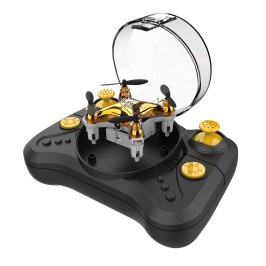
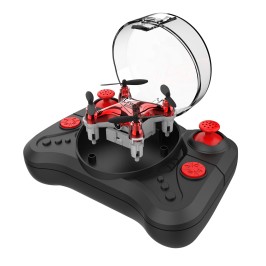
An ideal choice for a beginner would be the Mini Quadcopter RC Drone HT02 Black. This compact model has everything necessary for learning: a gyroscope for flight stabilization, 4-channel radio control, and sufficient flight time (about 7 minutes) for training. Thanks to its pocket-sized dimensions, you can take this drone anywhere, and its price won't break the bank, even if you need to buy spare parts after unsuccessful maneuvers.

What to Look for When Choosing Your First Drone
Size and Weight
For beginners, it's better to choose compact models. Small quadcopters are easier to control, less dangerous during collisions, and usually cheaper to repair. Mini-drones can even be used indoors, allowing you to practice regardless of weather conditions.
Gyroscope Presence
A gyroscope is a stabilization system that helps the drone maintain balance in the air. Without this feature, controlling a quadcopter becomes an extremely difficult task even for experienced pilots. All modern models, including budget ones, are equipped with gyroscopes, so make sure this feature is present.
Motor Type
There are two main types of motors for quadcopters: brushed and brushless. Brushed motors are cheaper but less powerful and durable. They're perfectly suitable for learning. Brushless motors are installed on more expensive models and provide better performance, but for your first steps in the world of drones, this isn't critical.
Flight Time and Battery
Budget quadcopters typically fly from 5 to 10 minutes on a single charge. This may seem short, but for learning purposes, it's quite sufficient. We recommend purchasing several spare batteries right away so you don't have to wait an hour or two between training sessions. Pay attention to battery capacity — the larger it is, the longer the drone can stay in the air.
Package Contents
Make sure the drone comes with a transmitter (remote control). Some models are controlled from a smartphone via Wi-Fi, but for learning, it's better to have a classic controller with joysticks — it provides more precise control.
First Steps: Preparing for Flight
Before launching your drone into the air, it's important to prepare properly. Here's a step-by-step guide for beginners:
Step 1: Study the Manual
This may seem obvious, but many beginners ignore the documentation and immediately try to take off. Each model has its own control, calibration, and maintenance features. Spend 15-20 minutes studying the manual — it will save you nerves and money.
Step 2: Charge the Batteries
Make sure the drone's battery and the batteries in the remote control are fully charged. Your first flight on a half-charged battery could end in an emergency landing.
Step 3: Choose the Right Location
For your first flights, choose an open space without trees, power lines, or people nearby. A park, field, or stadium would be ideal. If you have a mini-drone, you can practice at home in a large room, but remove all fragile objects.
Step 4: Check Weather Conditions
Wind is a beginner's main enemy. Even a light breeze can make control difficult for a novice. Choose calm days for your first flights. Also avoid rain and snow — most budget drones don't have moisture protection.
Basic Control Skills
Takeoff and Landing
Start with the simplest task — learn to take off and land smoothly. Place the drone on a level surface, slowly increase throttle until the quadcopter rises to a height of approximately 1 meter. Hold this altitude for a few seconds, then just as smoothly decrease throttle for landing. Repeat this exercise 10-15 times until you feel confident.
Holding Position
The next stage is learning to keep the drone in one place. This is harder than it seems, especially if your model doesn't have GPS stabilization. You'll need to constantly adjust the position with the joysticks, compensating for the drone's drift.
Moving Forward-Backward and Left-Right
Once you can confidently hold the drone in place, start practicing simple movements. Try slowly moving forward a few meters, then returning backward. Do the same with left-right movement. Don't rush — smooth, controlled movements are much more important than speed.
Turns
Turns (yaw) are one of the most difficult parts of control for beginners. When the drone rotates, the control orientation changes: what was "forward" becomes "left" or "backward." Start with smooth 90-degree turns, gradually increasing the difficulty.
Common Beginner Mistakes and How to Avoid Them
Mistake 1: Too Fast Movements
The most common mistake is abrupt joystick movements. This leads to loss of control and collisions. Always make smooth, slow movements, especially when starting to learn.
Mistake 2: Flying Too Far or High
Don't try to set altitude or distance records in your first days. The farther the drone is from you, the harder it is to assess its orientation and distance to obstacles. Stay within 10-15 meters until you feel confident.
Mistake 3: Ignoring Battery Level
When the battery drains, the drone starts losing power and can fall. Most models have a charge indicator — monitor it and land when 20-30% charge remains.
Mistake 4: Flying in Difficult Conditions
Don't try to fly near buildings, trees, or in rooms with lots of furniture until you've gained sufficient experience. Start in open space.
Quadcopter Maintenance
To ensure your drone lasts a long time, it's important to care for it properly. After each flight, check the propellers for cracks or damage. Clean the body of dust and dirt with a soft cloth. Store the quadcopter in a dry place, avoiding direct sunlight.
Batteries require special attention. Don't leave them completely discharged for extended periods and don't store them fully charged if you're not planning to fly soon. The optimal charge level for storage is 40-60%.
For storing the drone and accessories, it's convenient to use special organizers. For example, the Bulldog Black Key Organizer for Small Items can be a great solution for storing spare propellers, tools, and small parts — everything will be at hand and organized.
Expanding Your Capabilities
Once you've mastered basic control skills, you can think about expanding your capabilities. Some beginners become interested in radio-controlled toys of various types, as drone control skills easily transfer to other RC models. Others get into videography and move on to more advanced quadcopters with cameras.
It's also useful to explore the drone pilot community in your city. Group flights are not only fun but also beneficial: experienced pilots share tips, help set up equipment, and tell you about interesting places to fly.
Conclusion: Your Path to Confident Piloting
Learning to control a quadcopter is an exciting process that requires patience and practice. Start with a budget model like the Mini Quadcopter RC Drone HT02 Black, which will allow you to master basic skills without the risk of losing significant money on inevitable mistakes.
Remember the golden rules: always start simple, fly in safe conditions, make smooth movements, and don't rush. After just a few weeks of regular training, you'll notice significant progress. Drone control will become intuitive, and you'll be able to perform complex maneuvers that seemed impossible in the first days.
Most importantly — enjoy the process. Flying a quadcopter isn't just a technical skill, but a real hobby that opens new perspectives and brings lots of positive emotions. Good luck in mastering the skies!