



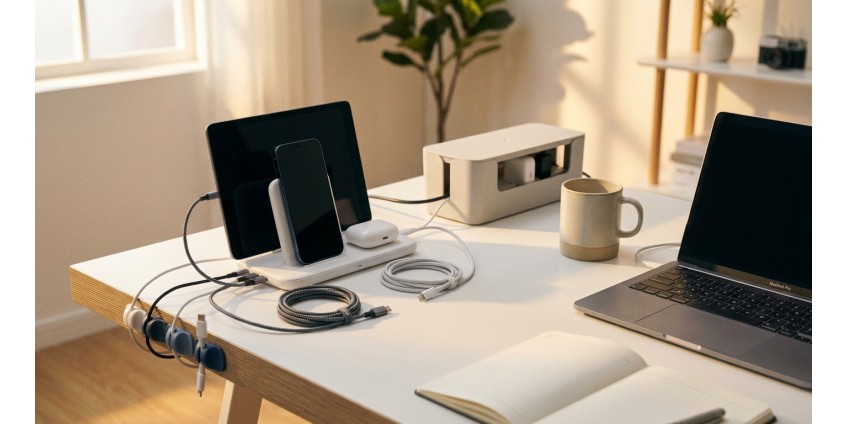
How to Organize Cable and Charger Storage at Home in 2026: Organizers, Life Hacks, and Systems for a Tidy Desk
Cable, charger, and adapter chaos—a familiar situation for anyone using modern gadgets. Smartphones, laptops, tablets, headphones, power banks—all these devices require regular charging, and the number of cables at home keeps growing. In 2026, the issue of organizing cable storage becomes especially relevant, as clutter on your desk not only ruins aesthetics but also hinders productivity and can even lead to damage of expensive accessories.
In this article, we'll take a detailed look at how to effectively organize cable and charger storage at home, which organizers to use, which life hacks will help maintain order, and which systems work best for different situations.
Why Proper Cable and Charger Storage Matters
Before moving on to specific solutions, it's worth understanding why organizing cable storage is not just a matter of aesthetics. First, tangled wires wear out faster: constant bending and knots damage the insulation, which can lead to short circuits or complete cable failure. Second, cable clutter makes it difficult to find the right cable—you waste time trying to untangle a mess or find the right charger among dozens of others.
Third, disorganized storage takes up more space than necessary. When cables are scattered across your desk or lying in a pile in a drawer, they create visual noise and distract attention. Finally, proper organization increases safety: neatly coiled and secured cables don't create a tripping hazard and are also protected from pets and children.
Basic Principles of Cable Organization
Before buying organizers, it's worth defining the basic principles that will help create an effective storage system. The first principle is sorting. Divide all cables by type: smartphone chargers, laptop cables, USB data transfer cables, audio cables, etc. This will help you quickly find the right wire and understand how much space is needed for each category.
The second principle is minimization. Honestly assess how many cables you actually need. Old, damaged, or duplicate cables are better thrown away or recycled. The third principle is accessibility. The most frequently used cables should be within reach, while rarely used ones can be stored in a designated place for long-term storage.
Cable Organizers: Types and Benefits
The modern market offers countless solutions for cable organization. Let's look at the most popular and effective options.
Cable Clips and Holders
These are simple but very effective devices that attach to the edge of a desk, wall, or other surface and keep cables in place. Clips come with adhesive backing or magnetic base. They're ideal for cables that are constantly used—for example, a smartphone charger by the bed or a USB cable on your desk. Thanks to such holders, the wire is always at hand and doesn't fall to the floor when you disconnect the device.
Cable Boxes
Cable boxes are enclosed containers with openings for routing wires. Power strips and extension cords are placed inside, while only the necessary cables come out. This system hides the unsightly tangle of wires and protects them from dust. Boxes are made of plastic or wood and can have different designs, allowing them to fit into any interior.
Cable Sleeves and Snake Organizers
If you have many wires going in the same direction (for example, from a computer to peripherals), a cable sleeve will help gather them into one neat bundle. Sleeves come in textile, plastic, or spiral varieties. They not only improve appearance but also make cleaning easier—instead of dozens of separate wires, you deal with one organized bundle.
Organizers for Storing Unused Cables
For cables that are rarely used, special organizers are suitable—these can be plastic or fabric cases with compartments, boxes with dividers, or even regular zip-lock bags. The main thing is to label each compartment or bag so you don't have to search for the right cable among others later. At the GadgetGuys store, you can find various cable organizers that will help maintain order.
Life Hacks for Cable Organization
Besides specialized organizers, there are many simple and budget-friendly ways to bring order to your wires.
Using Toilet Paper Tubes
One of the most popular life hacks is coiling cables and placing them in toilet paper tubes. Tubes can be placed vertically in a box or drawer, label each one—and you get a simple but functional organizer. This solution is ideal for storing chargers, short USB cables, and headphones.
Binder Clips and Office Clamps
Regular office binder clips can be used as cable holders on the edge of a desk. Attach a binder clip to the edge, thread the cable through it—and the wire will always be at hand, not falling to the floor. This is especially convenient for charging cables that you frequently connect and disconnect.
Cable Labeling
If you have many similar cables, labeling will be a real lifesaver. Use colored tape, tags, or special stickers to mark the purpose of each wire. For example, a red mark—phone charger, blue—tablet cable, green—printer wire. This saves time and reduces the likelihood of accidentally disconnecting the wrong device.
Velcro Cable Ties
Reusable velcro cable ties are a must-have for anyone dealing with cables. They allow you to neatly coil a wire and secure it, preventing tangling. Unlike regular plastic ties, velcro can be used repeatedly, making them a more eco-friendly and convenient option.
Systems for Maintaining Desk Order
The desk is where cables most often accumulate. Creating an effective system here is especially important for productivity and comfort.
Under-Desk Cable Trays
Special trays that attach to the underside of a desk allow you to hide power strips and excess cable loops. Wires pass through the tray and come out only where needed. This solution is especially popular in offices but works great at home too.
Desktop Charging Stations
Instead of having dozens of separate chargers, consider using a desktop charging station with multiple USB ports. Such a station takes up less space, reduces the number of wires, and allows you to charge multiple devices simultaneously. Many models also have stands for phones and tablets, which additionally saves space.
For a more comprehensive solution, you can use USB hubs, which not only expand the number of available ports but also help centralize the connection of all peripheral devices.
Cable Channels
If you have wires running along a wall or baseboard, cable channels will help hide them and create a neat appearance. Channels come with adhesive backing or screw mounting and are available in different colors to match your interior.
Organizing Charging Devices
Special attention should be paid to organizing the chargers themselves. If you have several family members, each with their own smartphone, tablet, or other gadget, the number of chargers can become a problem.
Family Charging Station
Create a centralized place for charging all devices. This can be a shelf, nightstand, or special organizer with compartments for each device. Make sure there are enough outlets nearby or use a power strip. Such a system not only brings order but also helps control gadget usage—especially relevant for families with children.
Mobile Organizers for Travel
For those who travel frequently, a compact organizer for cables and chargers will be useful. This can be a small pouch or case with elastic loops and pockets where each cable has its place. Such an organizer will help you quickly pack before a trip and not forget any important accessory.
Safety in Cable Storage
Don't forget about safety. Overloaded outlets and damaged cables can pose a fire hazard. Regularly check the condition of your wires—if you notice cracks in the insulation, exposed wires, or other damage, the cable needs to be replaced. Use quality charging devices from trusted manufacturers and avoid cheap counterfeits.
It's also important not to overload power strips. Even if an extension cord has 6-8 outlets, this doesn't mean all of them can be used simultaneously for high-power devices. Read equipment specifications and follow manufacturer recommendations.
Environmental Aspect
In 2026, more and more people are paying attention to the environmental friendliness of their solutions. Instead of throwing old cables in the trash, take them for recycling—many electronic components can be disposed of beneficially for the environment. Also choose reusable organizers instead of disposable solutions, use natural materials where possible.
Practical Summary
Organizing cable and charger storage is not a one-time action but an ongoing system that requires small but regular efforts. Start with sorting and minimizing: get rid of unnecessary wires, keeping only those that are actually used. Choose suitable organizers—clips for the desk, boxes for hiding extension cords, sleeves for grouping wires.
Use simple life hacks: toilet paper tubes, binder clips, labeling, and velcro ties will help maintain order without significant costs. Create a centralized charging station for the whole family and don't forget about safety—regularly check cable condition and don't overload outlets.
Proper cable organization not only improves the aesthetics of your space but also increases productivity, saves time, and protects your gadgets from premature wear. Invest a little time and effort in creating a storage system—and you'll feel the difference in just a few days. At the GadgetGuys store, you'll find all the necessary accessories for creating perfect order among your cables and charging devices.
Products related to this post

₴198 грн. ₴245 грн.
Add to Cart
₴79 грн.
Add to Cart
₴2,999 грн. ₴3,599 грн.
Add to Cart![Collectible figure Labubu Toy [FDM printing]](https://gadgetguys.com.ua/image/cache/catalog/easyphoto/5906/grashka-ruhliva-red-panda-chervona-panda-fdm-druk-1-266x266.png "Collectible figure Labubu Toy [FDM printing]")
