



How to Choose a Mini Quadcopter for a Child in 2026: Flight Safety, Battery Life, Controls, and First Steps in FPV
Mini quadcopters have become one of the most popular children's products in 2026. These compact flying devices not only entertain but also develop coordination, spatial thinking, and technical skills. If you're looking for your child's first drone, it's important to consider safety, ease of control, flight time, and learning opportunities. In this article, we'll explain what to look for when choosing a mini quadcopter and how to take the first steps into the exciting world of FPV flying.
Why a Mini Quadcopter Is the Perfect Choice for Beginners
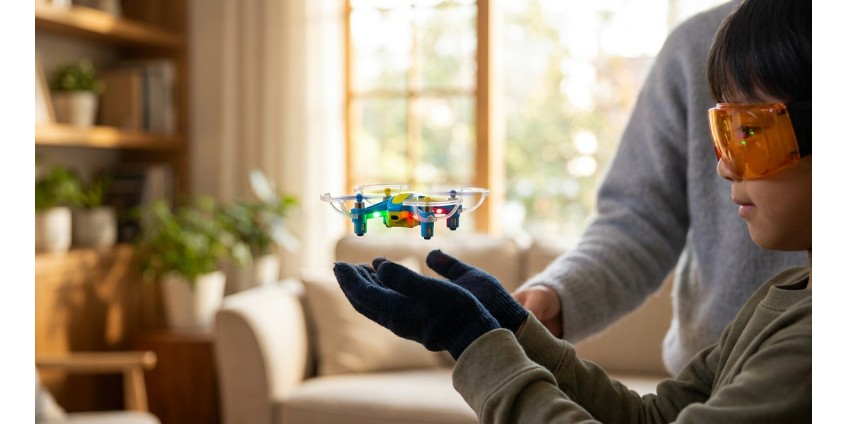
Mini quadcopters have several advantages over full-size models, especially when it comes to children. First, their compact size makes them safer for indoor use. Second, they're lighter and less likely to cause injury in case of collision. Third, such models are usually more affordable, allowing parents not to worry about accidental damage to expensive equipment during the learning process.
Pocket-sized quadcopters are ideal for mastering basic piloting skills. A child can learn to control the device in a safe environment, gradually progressing to more complex maneuvers. Most mini drones are equipped with gyroscopes that stabilize flight and make control easier for beginners.

Key Characteristics When Choosing a Children's Quadcopter
Flight Safety
Safety is the most important factor when choosing a quadcopter for a child. Look for protective rings around the propellers that prevent finger injuries and reduce damage when colliding with objects. Lightweight construction is also an advantage—the lighter the device, the lower the risk of damaging furniture or causing injury when falling.
It's important to choose models with automatic safety features: auto-hover, flip protection, automatic landing at low battery. These features help avoid emergency situations and extend the quadcopter's service life.
Battery Life and Battery Type
Flight time is a critically important characteristic that determines how much enjoyment a child will get from playing. Most mini quadcopters have a flight time of 5 to 10 minutes on a single charge. For example, the Mini Quadcopter RC Drone HT02 Black provides up to 7 minutes of continuous flight thanks to its 3.7V 200mAh battery.
While 7 minutes may seem like a short period, for beginners it's quite sufficient for one training session. Children don't get tired, and the battery is enough to master basic maneuvers. We recommend purchasing several spare batteries to extend playtime without long waits for recharging.
Control Type and Range
For children, quadcopters with simple 4-channel radio control work best. Such models allow control of basic movement directions: forward-backward, left-right, rotation, and altitude. The remote control should be ergonomic, with clear control elements that fit comfortably in children's hands.
The presence of a gyroscope significantly simplifies control by automatically stabilizing the quadcopter in the air. This allows the child to focus on maneuvering rather than keeping the device airborne. Mini quadcopters typically have a range of up to 30-50 meters, which is quite sufficient for indoor flights and small outdoor spaces.
Size and Portability
Pocket quadcopters have an obvious advantage—they can be taken anywhere. The compact size allows you to fit the drone in a backpack or even a pocket, making it an ideal companion for trips, picnics, or visits to friends.
Small size also means the ability to fly indoors, even in a regular room. This is especially relevant during cold seasons or rainy weather when outdoor activity is limited. Children can practice year-round, regardless of weather conditions.
Motor Types: Brushed vs Brushless
Mini quadcopters for beginners are usually equipped with brushed motors. They're simpler in construction, cheaper to produce, and quite sufficient for training flights. Brushed motors have less power and shorter service life compared to brushless ones, but for children's models this isn't critical.
Brushless motors are installed on more professional models. They're more powerful, efficient, and durable, but also significantly more expensive. For a child's first quadcopter, a brushed motor will be the optimal choice in terms of price-to-functionality ratio.
First Steps in FPV Piloting
FPV (First Person View) is piloting with a first-person view, where the pilot sees what the quadcopter's camera sees. This is the next level after mastering basic control. Although most entry-level mini quadcopters don't have built-in FPV cameras, they create a solid foundation for future transition to FPV models.
To prepare a child for FPV piloting, it's important to first master visual control—when the pilot sees the drone with their eyes. This develops spatial orientation, understanding of flight physics, and reaction speed. When these skills are established, the transition to FPV will be much easier.
Learning Process: Step-by-Step Approach
Start with simple exercises indoors without obstacles. The first task is to learn to smoothly lift the quadcopter to a low altitude and hold it in place. Then add forward-backward, left-right movement. When the child confidently performs these maneuvers, move on to rotation and circular flights.
The next stage is creating simple obstacles or routes. You can use chairs, boxes, or special drone rings. Flying through obstacles develops control precision and concentration. Gradually complicate the courses by adding more elements.
Additional Features and Capabilities
Modern mini quadcopters often have additional features that make flights more interesting. Among them:
- Headless flight mode—the quadcopter moves relative to the pilot, not its own orientation, which simplifies control for beginners
- One-button return function—the drone automatically returns to the starting point
- Trick capabilities—performing 360-degree flips with one button
- Speed adjustment—ability to choose slow mode for learning or fast for experienced pilots
- LED lighting—makes the quadcopter visible at dusk and adds spectacle
What's Included in the Package
When purchasing a mini quadcopter, pay attention to what's included. The standard set usually includes the drone itself, remote control, battery, USB charging cable, and instructions. Some manufacturers add spare propellers, which is very useful since they're the most vulnerable part of the quadcopter.
Make sure the transmitter is included in the package. Some models are sold without a remote, which can be an unpleasant surprise after purchase. Also clarify whether batteries are needed for the remote control, and if so, what type.
Maintenance and Care
Mini quadcopters are quite undemanding in maintenance, but a few simple rules will extend their service life. After each flight, clean the propellers of dust and dirt with a soft cloth. Check the propeller mounts—they should be securely fixed but not overtightened.
Batteries shouldn't be completely discharged—this reduces their lifespan. Store batteries at room temperature with about 50-60% charge. Don't leave the quadcopter in direct sunlight or in very cold places.
Age Recommendations and Safety Training
Most mini quadcopters are recommended for children aged 8 and older. Younger children can control the drone under adult supervision. It's important to teach the child safe piloting rules from the very beginning:
- Don't fly near people, animals, or valuable objects
- Don't use the quadcopter near water without waterproof protection
- Don't fly outdoors in strong wind
- Always check battery charge before flight
- Land at the first signs of unstable flight
Practical Summary
Choosing a mini quadcopter for a child in 2026 is an investment in developing technical skills, coordination, and spatial thinking. When selecting a model, safety should be the priority: protective rings on propellers, lightweight construction, presence of a gyroscope for stabilization. Flight time of 5-10 minutes is standard for mini models, so it's worth considering purchasing additional batteries.
For beginners, models with brushed motors and simple 4-channel control are ideal. They're affordable and reliable in operation. Pocket sizes allow flying both indoors and outdoors, making such children's toys universal for any season.
Start training with simple exercises in a safe environment, gradually increasing task difficulty. When basic skills are established, you can move on to flying through obstacles and preparing for future mastery of FPV piloting. The main things are patience, regular practice, and adherence to safety rules. With a properly chosen mini quadcopter, your child will get not only an exciting hobby but also valuable skills that will be useful in the future.
Products related to this post

₴79 грн.
Add to Cart

₴76,230 грн. ₴101,768 грн.
Add to Cart