How to Choose a Desk Lamp for a Student in 2026: Workspace Lighting, Lamp Types, Brightness Control, and Child Eye Protection
Proper lighting for a student's workspace is not just a matter of comfort, but an important component of a child's health. The quality of light affects vision, fatigue levels during homework, and overall learning productivity. In 2026, the choice of desk lamps is extremely wide, so it's important for parents to understand the key criteria that will help make the right choice.
Why Quality Lighting is Critically Important for Students
A child's eyes are in the developmental stage until approximately 18 years of age. That's why improper lighting can cause the development of myopia, astigmatism, and other vision problems. During reading, writing, or computer work, the eyes experience significant strain, and insufficient or overly bright light only exacerbates this problem.
Statistics show that over 30% of students have vision problems, and one of the reasons is improper workspace organization. A desk lamp should provide even lighting without harsh shadows and glare, creating comfortable conditions for prolonged work.
Main Types of Lamps for Desk Lighting
LED Lamps: The Modern Standard
LED lamps have become the gold standard in 2026 thanks to numerous advantages. They consume minimal electricity, have a long service life (up to 50,000 hours), and don't heat up during operation. LED technology allows creating light that is as close as possible to natural daylight, which is best suited for children's eyes.
Modern LED lamps are often equipped with color temperature adjustment function—from warm yellow to cool white light. For studying, neutral white temperature in the range of 4000-4500K is considered optimal, as it doesn't tire the eyes and promotes concentration.
Halogen Lamps: Classic with Limitations
Halogen lamps provide bright light close to natural, but have significant disadvantages. They heat up considerably during operation, which can be dangerous for a child, consume more electricity, and have a shorter service life compared to LED. In 2026, their use for children's workspaces is practically not recommended.
Fluorescent Lamps: Outdated Technology
Compact fluorescent lamps (energy-saving) were once popular, but today they are inferior to LED in all parameters. They contain mercury, have flickering (even imperceptible to the eye, it tires vision), warm up slowly, and don't support smooth brightness adjustment.
Key Characteristics of a Desk Lamp for Students
Power and Brightness
For comfortable reading and writing, an illumination level of 300-500 lux on the work surface is necessary. For LED lamps, this corresponds to a power of 7-12 W. It's important that the lamp provides sufficient brightness without excessive eye strain.
Overly bright light creates discomfort and glare on paper, while insufficient light forces the child to strain their vision. Therefore, the optimal solution is a lamp with brightness adjustment capability, which will allow adapting the lighting to different tasks and times of day.
Brightness and Color Temperature Adjustment
The dimming function (brightness adjustment) is not a luxury, but a necessity. In the morning, when there's plenty of natural light in the room, minimal lamp brightness is sufficient. In the evening, when it's dark outside, maximum lighting level is needed. The ability to smoothly adjust allows creating ideal conditions at any time.
Color temperature adjustment is also important. Warm light (3000K) relaxes and is suitable for evening reading before bed, neutral white (4000-4500K) is ideal for studying and doing homework, and cool white (5500-6000K) helps focus during complex tasks.
Design and Flexibility
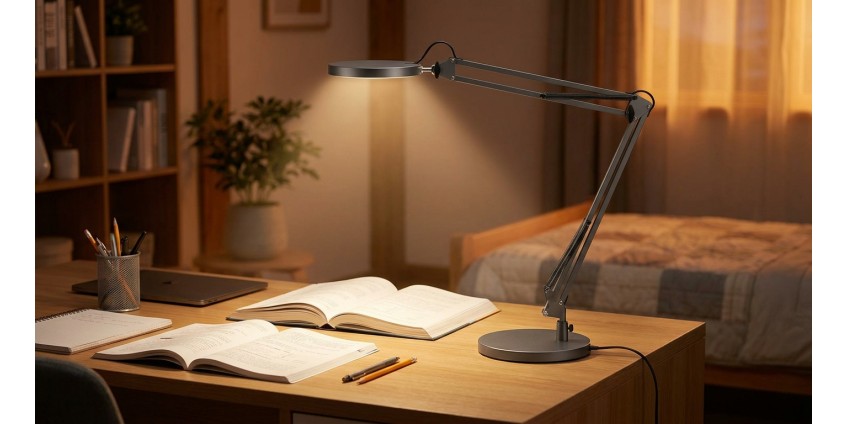
A desk lamp should have a flexible arm or articulated mount that allows directing light precisely to the work area. A stable base prevents tipping, which is especially important for younger students who may accidentally knock over the lamp.
The optimal lamp height above the work surface is 30-45 cm. Light should fall from the side (from the left for right-handers, from the right for left-handers) so that the hand doesn't cast a shadow on the notebook or book. The illumination area should cover the entire work zone of the desk.
Flicker Protection
Quality LED lamps are equipped with drivers that completely eliminate light flickering. Even if flickering is imperceptible to the naked eye, it negatively affects the nervous system, causes fatigue and headaches. When choosing a lamp, make sure the manufacturer guarantees the absence of flickering (flicker-free technology).
Additional Features of Modern Desk Lamps
USB Ports for Charging
Many modern desk lamps are equipped with USB ports, which allows charging a smartphone, tablet, or other gadgets directly on the desk. This is convenient and helps maintain order by reducing the number of wires.
Timer and Reminders
Some models have a built-in timer that reminds about the need to take a break. This is a useful function, as students often forget about rest during homework. Ophthalmologists recommend taking a 5-10 minute break every 40-45 minutes of work.
Night Light Mode
Lamps with a night light function provide soft, dim light that doesn't interfere with sleep but allows the child to comfortably navigate the room at night. This is especially relevant for younger students.
What to Pay Attention to When Choosing
Certification and Safety
Choose lamps from trusted manufacturers that have quality and safety certificates. Products should comply with European standards (CE) and sanitary norms. Check if there's a sharp chemical smell from the plastic—this may indicate low-quality materials.
Body Materials
Quality plastic or metal should be durable and safe. Avoid lamps with overly light, brittle plastic—they break quickly. The base should be heavy and stable so the lamp doesn't tip over.
Power Type
Most desk lamps operate from 220V mains, but there are models with a battery that can be used without being tied to an outlet. Battery-powered lamps are convenient for trips to the countryside or in case of power outages, but for permanent use, it's better to choose a mains model.
Proper Lamp Placement on the Desk
Even the best lamp won't be beneficial if placed incorrectly. Light should fall from the side, not from the front or back. For a right-handed child, the lamp is placed on the left, for a left-hander—on the right. This prevents the formation of a shadow from the hand on the work surface.
It's important to combine local lighting from the desk lamp with general room lighting. Working only by desk lamp light in a dark room is harmful to vision due to excessive contrast. Turn on overhead lighting or a floor lamp to create a comfortable illumination level throughout the room.
Organizing a Student's Workspace
Besides proper lighting, it's important to organize the entire workspace. There should be no unnecessary items on the desk that distract attention. All necessary study materials should be at hand but neatly arranged.
To maintain order on the desk, it's useful to use organizers and storage systems. In our store, you'll find a wide selection of products in the Home Products category, which will help create a convenient and functional workspace for a student.
Don't forget about the correct height of the chair and desk—the child's feet should be on the floor, and elbows should rest freely on the desk. Place the computer monitor or laptop at a distance of 50-70 cm from the eyes, the top of the screen should be at or slightly below eye level.
Desk Lamp Maintenance
Regularly wipe the shade and lamp base from dust—contamination reduces light brightness by 20-30%. Use a soft dry cloth or slightly damp fabric. Check the condition of the cord and plug, especially if the lamp is used actively.
LED lamps practically don't require light source replacement thanks to their long service life, but if you notice that brightness has decreased or the light has become yellowish, it may be time to replace the lamp with a new one.
Ophthalmologists' Tips on Workspace Lighting
Ophthalmologists recommend following simple rules to preserve a child's vision. Every 40-45 minutes of desk work, take a 10-15 minute break. During the break, it's useful to do eye exercises or simply look out the window at distant objects.
Control the distance from eyes to book or notebook—it should be 30-35 cm. Teach the child to maintain proper posture during studying: straight back, feet on the floor, elbows on the desk.
If the child complains of eye fatigue, headaches after doing homework, eye redness—this is a reason to check the quality of lighting and schedule a consultation with an ophthalmologist. Early detection of vision problems allows for successful correction.
Budget for Buying a Desk Lamp
A quality LED desk lamp with brightness and color temperature adjustment costs from 800 to 3000 hryvnias. You shouldn't economize on a child's health by choosing the cheapest models without quality certificates. At the same time, there's no need to overpay for excessively expensive branded models with features that will never be used.
The optimal range for a quality lamp with all necessary functions is 1200-2000 hryvnias. Such an investment will pay off with the child's comfort and preservation of their vision.
Summary: What to Pay Attention to When Choosing
Choosing a desk lamp for a student is a responsible task on which the health of the eyes and the child's academic success depend. Let's summarize the key points to pay attention to:
- Choose LED lamps with neutral white light temperature of 4000-4500K
- Make sure the lamp has a brightness adjustment function
- Check for flicker-free technology
- Choose a model with a flexible arm or articulated mount
- Ensure the base is stable and materials are quality
- Look for certified products from trusted manufacturers
- Place the lamp to the side of the child (left for right-handers, right for left-handers)
- Combine local lighting with general room lighting
A properly organized workspace with quality lighting will help your child study comfortably while preserving eye health for years to come. Don't forget about regular breaks during classes and visiting an ophthalmologist for preventive examinations.
In our GadgetGuys online store, you'll find a wide assortment of products for organizing comfortable living. Browse the Lighting category, which features various options for your home. We also recommend checking out the Children's Products section, where you'll find everything necessary for your child's learning and development.
Products related to this post
₴5,999 грн. ₴9,499 грн.
Add to Cart
₴2,999 грн. ₴3,599 грн.
Add to Cart