



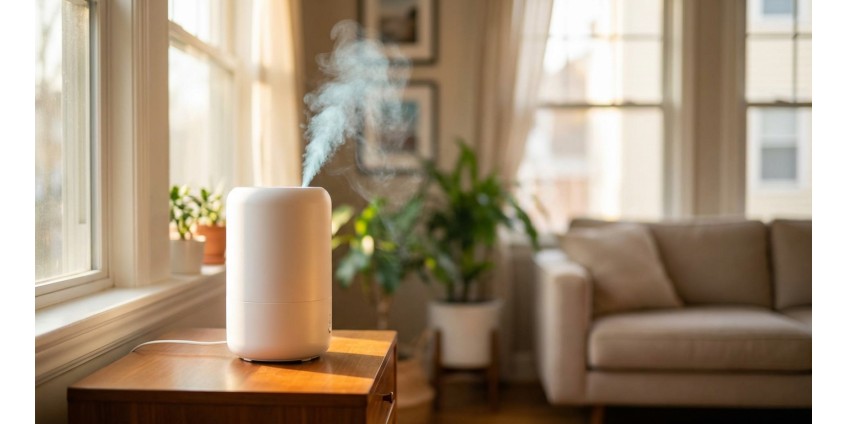
How to Choose a Humidifier for Your Apartment and Office: Types, Coverage Area, Hygrostats, and Maintenance in 2026
Why Indoor Humidity Matters
Optimal humidity levels in an apartment or office are not just a matter of comfort, but also health. Medical professionals recommend maintaining levels between 40% and 60%, as these conditions allow our bodies to function at their best. Excessively dry air leads to drying of the nasal and throat mucous membranes, making us more vulnerable to viral infections, especially during cold seasons.
Beyond health impacts, low humidity negatively affects skin—it becomes dry, flaky, and feels tight. Wooden furniture and parquet flooring also suffer from overly dry air: wood can warp, crack, and lose its original appearance. Musical instruments, especially stringed and wooden wind instruments, require stable humidity to preserve their sound quality and structural integrity.
In office spaces, dry air reduces employee productivity, causes fatigue, headaches, and eye irritation. This is why humidifiers have become an integral part of modern office spaces and home interiors.
Main Types of Humidifiers
The market offers several main types of humidifiers, each with its own advantages and usage characteristics. Understanding the differences between them will help you make the right choice according to your needs.
Ultrasonic Humidifiers
The most popular type thanks to high efficiency and quiet operation. The operating principle is based on converting water into cool mist using high-frequency vibrations of a special membrane. Ultrasonic models consume little electricity, are compact and convenient to use. The main recommendation is to use distilled or filtered water to avoid white residue on furniture from salts contained in tap water.
Steam Humidifiers
They work on the principle of boiling water and evaporating steam. Such devices quickly increase humidity even in large rooms and kill bacteria thanks to the high temperature of the steam. However, they consume more electricity, can be dangerous for children due to hot steam, and also raise the room temperature by several degrees.
Traditional (Evaporative) Humidifiers
The safest type for children's rooms. Water naturally evaporates through special filters or cartridges, while the air cools by 1-2 degrees. Such humidifiers cannot over-humidify the air—the process stops when natural balance is achieved. The disadvantage is the need for regular filter replacement and relatively slow operation.
Air Washers
Combined devices that simultaneously humidify and purify air from dust, allergens, and fine particles. An ideal option for allergy and asthma sufferers. The operating principle is similar to traditional humidifiers, but with an additional filtration system. The cost of such devices is higher, but they perform two functions simultaneously.
How to Determine the Required Coverage Area
One of the most important parameters when choosing a humidifier is the area it's designed to cover. Manufacturers typically specify this characteristic in technical data. For a standard apartment with rooms of 15-20 m², a model with coverage up to 30 m² is suitable. If you plan to use the humidifier in a living room or open space office of 40-50 m², choose corresponding models with higher capacity.
It's important to consider not only the area but also ceiling height. For rooms with ceilings higher than 3 meters, you need a humidifier with greater power reserve. Also pay attention to productivity—the amount of moisture the device can evaporate per hour. For a 20 m² room, the optimal indicator is 200-300 ml/hour.
If you have a large apartment or house, it's better to install several humidifiers in different rooms rather than relying on one powerful device. Air doesn't circulate quickly enough between closed rooms, so one humidifier won't provide comfortable humidity in all rooms simultaneously.
Hygrostat and Automatic Regulation
A hygrostat is a sensor that measures humidity levels in a room and automatically regulates the humidifier's operation. Models with a built-in hygrostat are much more convenient to use, as they don't require constant monitoring. You simply set the desired humidity level (for example, 50%), and the device automatically turns on and off to maintain this indicator.
Humidifiers without a hygrostat work continuously until you turn them off manually. This can lead to over-humidification, which is also dangerous—condensation appears on windows, creating conditions for mold and fungus development. Therefore, having a hygrostat is not just convenience, but also protection for your home.
Modern models may have a digital display that shows the current humidity level in real time. Some devices integrate with smart home systems and are controlled via mobile app, allowing you to control the microclimate even remotely.
Tank Capacity and Continuous Operation Time
The water tank volume determines how long the humidifier can operate without refilling. For a bedroom, a model with a 3-4 liter reservoir is usually sufficient—this will last all night. For an office or large living room, it's better to choose devices with a 5-7 liter tank so you don't have to frequently add water throughout the day.
Pay attention to the tank design. It should be easy to remove for filling and cleaning, with a wide opening for convenient washing. Some models allow you to add water from the top without removing the tank, which is very convenient to use.
The automatic shut-off function when water runs out is also useful. This protects the device from overheating and extends its service life. A water level indicator will help you notice in time when you need to refill the reservoir.
Additional Features and Capabilities
Modern humidifiers offer many additional options that make use more comfortable. Air ionization saturates it with negatively charged ions, which improves well-being and purifies from dust. Aromatherapy allows you to add essential oils to create a pleasant aroma in the room—especially relevant for spas, yoga studios, or simply for relaxation at home.
Night mode reduces noise level and lighting brightness so as not to disturb sleep. A timer allows you to program operating time—for example, turn on the humidifier an hour before you return home. A UV lamp disinfects water in the reservoir, killing bacteria and microorganisms, which is especially important for children's rooms.
Some models have a water heating function to accelerate evaporation or, conversely, air cooling on hot days. Remote control via remote or Wi-Fi makes use as convenient as possible.
Maintenance and Care Guidelines
Regular care of your humidifier is the key to its long and effective operation. Check the water level daily and refill as needed. Once a week, be sure to wash the reservoir with warm water and mild detergent, rinse thoroughly. This prevents bacterial buildup and unpleasant odors.
To clean the ultrasonic membrane, use a soft brush or special products from the manufacturer. Remove limescale with a solution of citric acid or vinegar—leave for 20-30 minutes, then rinse thoroughly. Filters in traditional humidifiers and air washers need to be changed according to manufacturer recommendations, usually every 2-3 months.
If you don't use the humidifier for an extended period, completely drain the water, dry all parts, and store in a dry place. Use filtered or distilled water to minimize scale formation. Don't add foreign substances to the water, except for special products recommended by the manufacturer.
To maintain cleanliness in the room, regularly wipe surfaces from possible white residue that may form when using hard water in ultrasonic models. Place the humidifier on a level surface at least 30 cm from walls and furniture to ensure normal air circulation.
What to Look for When Buying
When choosing a humidifier in a store, pay attention to noise level—especially important for bedrooms and children's rooms. An indicator up to 25 dB is considered quiet, up to 35 dB—acceptable for daytime use. Check the quality of materials—plastic should be sturdy, without sharp odor, all parts should fit tightly together.
Evaluate ease of control—buttons should press easily, the display should be clear and understandable. If possible, ask the seller to demonstrate the device's operation. Clarify warranty availability and service centers in your city, availability of spare parts and filters.
Compare prices for different models with similar characteristics. Sometimes overpaying for a brand isn't justified, and less-known manufacturers offer quality devices at more affordable prices. Read reviews from real users—they often point out disadvantages that aren't obvious from technical specifications.
If you need home accessories, pay attention to various categories in our store. For example, to create a comfortable atmosphere, dehumidifiers may come in handy, which solve the opposite problem in excessively humid rooms. Also, to ensure stable operation of electrical appliances, we recommend checking out power strips, adapters, and extension cords, which will protect your equipment from voltage surges.
Practical Summary
Choosing a humidifier is an investment in the health and comfort of your family or team. For an apartment, the optimal choice would be an ultrasonic humidifier with a hygrostat, a 3-5 liter tank capacity, and coverage area corresponding to your room size. For an office, consider an air washer with purification function or a more powerful steam humidifier.
Be sure to consider the presence of a hygrostat for automatic maintenance of optimal humidity levels of 40-60%. Don't forget about regular maintenance—weekly tank washing and timely filter replacement. Use filtered water to extend the device's service life and prevent white residue on furniture.
When choosing a model, focus not only on price, but also on real needs: room area, presence of children, noise level, ease of maintenance. A properly selected and regularly maintained humidifier will create a healthy microclimate in your home or office for many years.
Products related to this post

₴2,999 грн. ₴3,599 грн.
Add to Cart
![Collectible figure Labubu Toy [FDM printing]](https://gadgetguys.com.ua/image/cache/catalog/easyphoto/5906/grashka-ruhliva-red-panda-chervona-panda-fdm-druk-1-266x266.png "Collectible figure Labubu Toy [FDM printing]")