



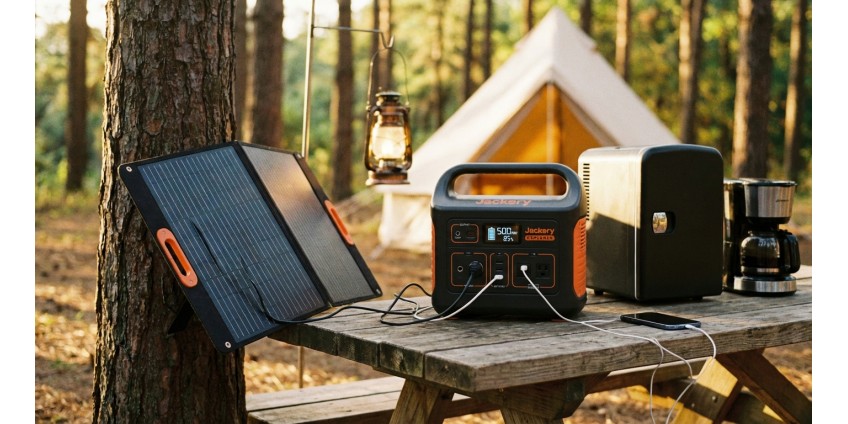
How to Choose a Portable Power Station for Camping, Power Outages, and Off-Grid Living in 2026: Capacity, Power Output, and Sola
Why a Portable Power Station Became Essential in 2026
Today's realities have forced us to reconsider our approach to energy independence. Power outages, trips to the countryside, camping, or simply the desire to have a backup power source – all of this makes a portable power station not a luxury, but an essential gadget for every family. Unlike regular power banks, power stations can power not only smartphones, but also laptops, mini-fridges, lighting devices, and even household appliances.
In this article, we'll thoroughly examine what to look for when choosing a portable power station, so your purchase will be as justified and useful as possible in any conditions.
Key Characteristics of Portable Power Stations
Battery Capacity: How Many Watt-Hours Do You Need
Capacity is the first parameter that determines how long the station can power your devices. It's measured in watt-hours (Wh) or amp-hours (Ah). To understand: a 500 Wh station can charge a smartphone (15 Wh) about 30 times, or power a laptop (50 Wh) for 10 hours.
Different capacities are recommended for different usage scenarios:
- 300-500 Wh – for short trips outdoors, charging gadgets, tent lighting
- 500-1000 Wh – for the countryside, extended camping, powering laptops and drones
- 1000-2000 Wh – for full backup power at home, running power tools
- Over 2000 Wh – for extended autonomy, powering refrigerators, heaters
Power Output: What Your Station Can Power
Power output (W) determines which specific devices you can connect. This is no less important than capacity. For example, a station with 1000 Wh capacity but only 300 W output won't be able to run a 1500 W electric kettle, even though it theoretically has enough energy.
Typical consumers and their power requirements:
- Smartphone: 10-20 W
- Laptop: 40-90 W
- LED lamp: 10-20 W
- Mini-fridge: 50-100 W
- Electric kettle: 1000-1500 W
- Work laptop: 65-90 W
- Drone (charging): 60-100 W
Also pay attention to peak power – some devices consume more energy during startup than during operation.
Port Types and Quantity
Modern power stations are equipped with various ports for connection:
- USB-A – standard ports for smartphones, tablets, headphones
- USB-C – fast charging for modern gadgets, can support Power Delivery up to 100 W
- AC outlets 220V – for connecting regular household appliances
- DC outputs – for car accessories and specialized equipment
- Wireless charging – convenient option for smartphones with Qi support
The more ports – the more devices you can charge simultaneously, but this also affects the overall cost of the station.
Solar Panel Compatibility: Unlimited Autonomy
One of the most important advantages of modern portable power stations is the ability to recharge from solar panels. This makes you completely independent from the power grid, which is especially relevant for extended trips to the countryside or camping.
What to Look for When Choosing a Station with Solar Panel Support
When choosing a station you plan to use with solar panels, consider:
- Maximum solar input power – the higher it is, the faster charging will occur
- Connector type – make sure your panels are compatible with the station
- MPPT controller – technology that optimizes the solar charging process, increasing efficiency by 20-30%
- Overvoltage protection – important for safe operation with solar panels
If you plan to use the power station in the countryside or camping, definitely consider options from the portable solar panels category, which will perfectly complement your autonomous power system.
How Long Does Solar Charging Take
Charging time depends on the solar panel power and station capacity. For example, a 500 Wh station can be fully charged in 5-6 hours using a 100 W panel in sunny weather. For a 1000 Wh station, you'll need either 10-12 hours with a 100 W panel, or 5-6 hours with a 200 W panel.
Additional Features That Make Usage More Convenient
Modern portable power stations aren't just batteries with outlets. Manufacturers add many useful features:
- LED display – shows remaining charge, power consumption, time until full discharge
- Built-in flashlight – useful for camping and during power outages
- UPS mode – uninterruptible power supply, the station automatically switches to battery when power is lost
- Mobile app – remote monitoring and station control
- Capacity expansion capability – some models allow connecting additional batteries
- Protection against overheating, overcharging, short circuit – basic safety features
Usage Scenarios: From Camping to Emergency Backup
For Camping and Outdoor Recreation
On camping trips, a portable power station will become your indispensable assistant. It will allow you to charge smartphones, quadcopters for aerial photography, power tent lighting, work with a laptop, and even cook food on a portable electric stove. For such purposes, an optimal station is 500-800 Wh with a weight up to 7 kg.
For Countryside and Garden
In the countryside, where power supply can be unstable or completely absent, a power station will ensure lighting operation, tool charging, and powering irrigation pumps. Combined with solar panels, you'll get a completely autonomous system. Recommended capacity – from 1000 Wh.
For Home Backup Power
During power outages, a portable station will ensure operation of the most essential devices: lighting, gadget charging, router for internet, laptop for work. For such needs, consider models from 1000 Wh with UPS function and fast switching capability.
For Remote Work
Photographers, videographers, freelancers who love working outdoors will appreciate the ability to power laptops, charge cameras, drones, and other equipment without being tied to outlets. A 500-700 Wh station will provide a full working day.
What Else to Consider When Choosing
Weight and Dimensions
Portability is a relative concept. Stations at 500 Wh weigh 5-7 kg, at 1000 Wh – 10-13 kg, and more powerful models can weigh over 20 kg. If you plan to frequently carry the station, pay attention to the presence of handles and compact design.
Charging Time from Mains
Charging speed from a 220V outlet is an important parameter. Modern stations can charge in 1.5-8 hours depending on capacity and charger power. Some models support fast charging, allowing 80% capacity recovery in an hour.
Operating Temperature Range
If you plan to use the station in winter, check what temperatures it can operate at. Most models are designed for a range from -10°C to +40°C, but some may have limitations.
Warranty and Service
A portable power station is an investment for years. Choose models with a minimum 2-year warranty and service centers available in Ukraine. Lithium iron phosphate batteries (LiFePO4) have a greater charge cycle life compared to lithium-ion – up to 3000 cycles versus 800-1000.
Safety of Using Portable Power Stations
Although modern stations are equipped with numerous protection systems, it's important to follow basic safety rules:
- Don't leave the station under direct sunlight in heat
- Don't use in rain without special protection
- Don't overload the station by connecting devices with total power above maximum
- Store with a charge level of 40-60% to extend battery life
- Don't allow complete discharge for extended periods
Practical Summary: How to Make the Right Choice
Choosing a portable power station depends on your specific needs. Here's a quick checklist for making a decision:
- Define your needs: make a list of devices you plan to power and their power requirements
- Calculate required capacity: multiply power by operating hours, add 20-30% reserve
- Check power output: make sure the station can handle your most powerful device
- Assess portability: can you comfortably carry a station of this weight
- Think about solar panels: if you plan autonomy, choose a model with good solar charging support
- Compare prices: divide cost by capacity in Wh – you'll get the price per energy unit for comparison
A portable power station isn't just a gadget, but an investment in your energy independence, comfort, and peace of mind. A properly chosen model will serve you for years, providing electricity in any conditions – whether it's romantic camping under the stars, working in the countryside, or an emergency power outage at home. Carefully analyze your needs, compare specifications, and make a choice that will provide you with maximum comfort and functionality.
Don't forget to also consider other useful gadgets from the power stations and additional batteries category, which will help create a comprehensive power supply system for any situation.
Products related to this post


₴5,999 грн. ₴9,499 грн.
Add to Cart
![Collectible figure Labubu Toy [FDM printing]](https://gadgetguys.com.ua/image/cache/catalog/easyphoto/5906/grashka-ruhliva-red-panda-chervona-panda-fdm-druk-1-266x266.png "Collectible figure Labubu Toy [FDM printing]")