



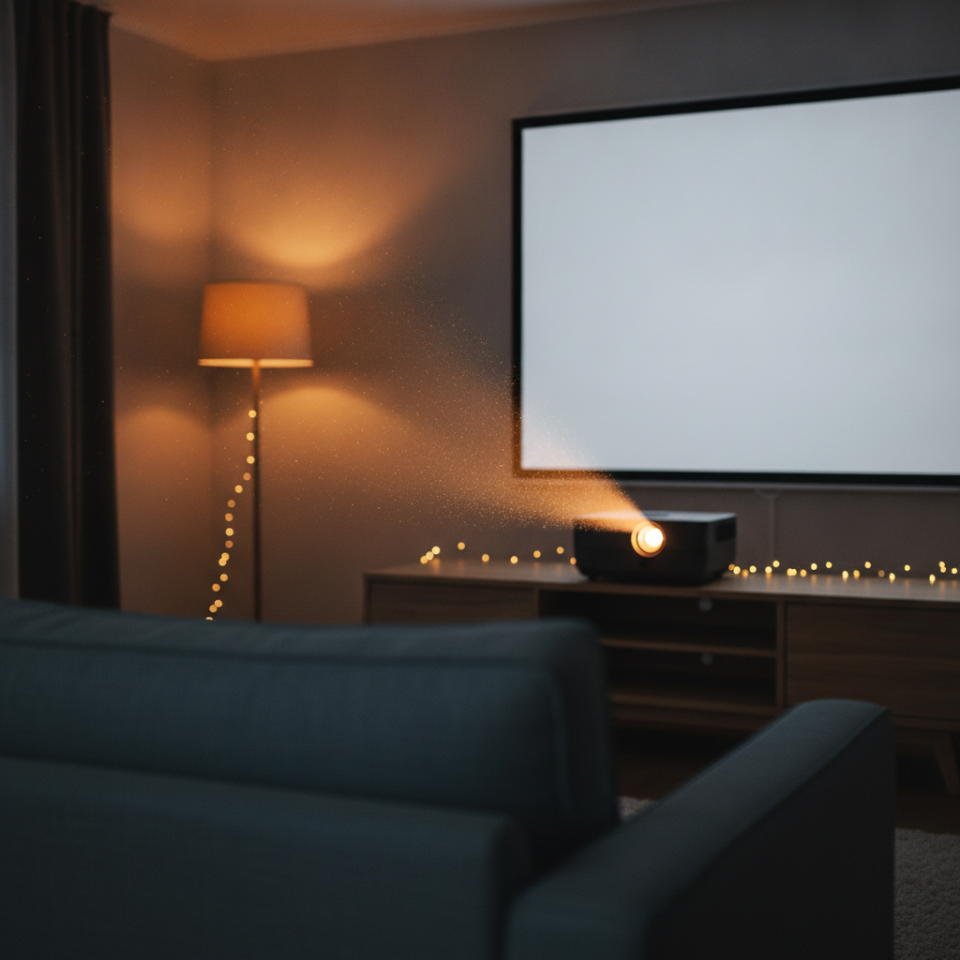
A projector is not just a "big TV". It is a separate class of device with its own buying logic: some models are built for films in a darkened room, others for office presentations where nobody is going to switch the lights off. Buyers rarely go wrong with the brand; they go wrong with the numbers on the box. "9000 lumens", "4K" and "short-throw" mean something quite different from what they seem. Below is what to actually look at and what to expect from a 2,400–5,300 UAH mini projector compared with an office BenQ.
ANSI lumens vs. "marketing" lumens: why 9000 on the box doesn't light up the wall
Honest brightness is measured in ANSI lumens: light output is measured at nine points on the screen and averaged. Boxes of cheap LED/LCD projectors often say 8000–15000 "lumens" or "lux". At best that is the output of the LED itself before the LCD panel and optics, not what reaches the wall. Real figures for these units are an order of magnitude lower.
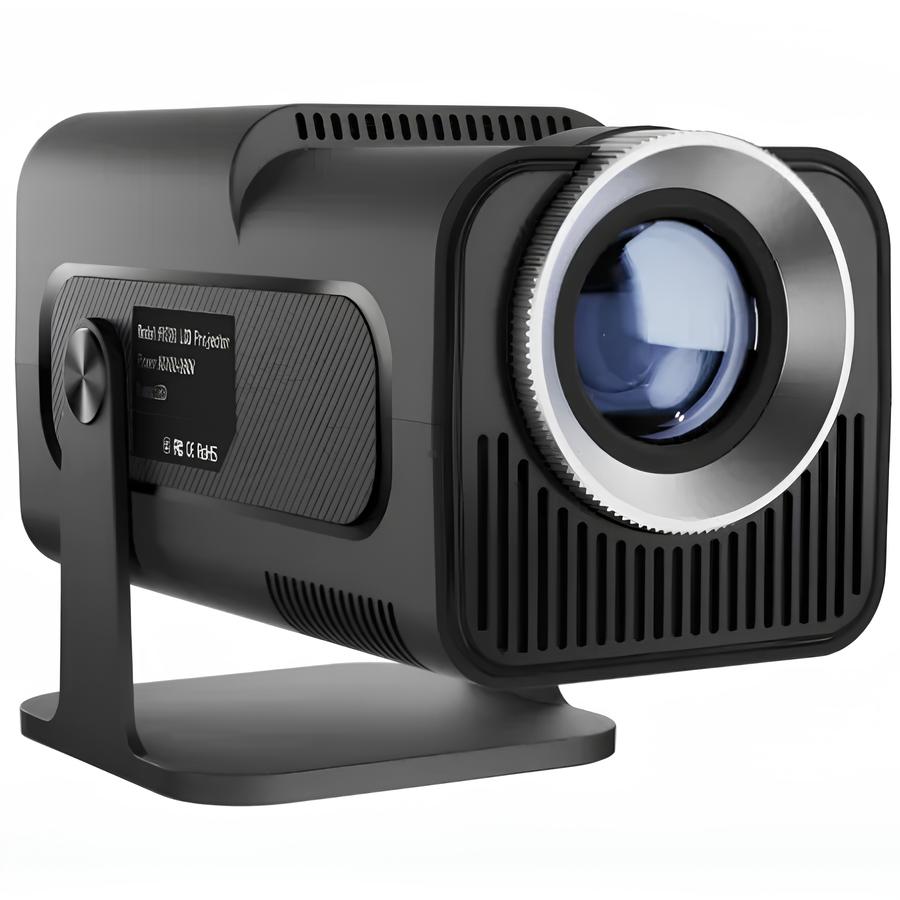
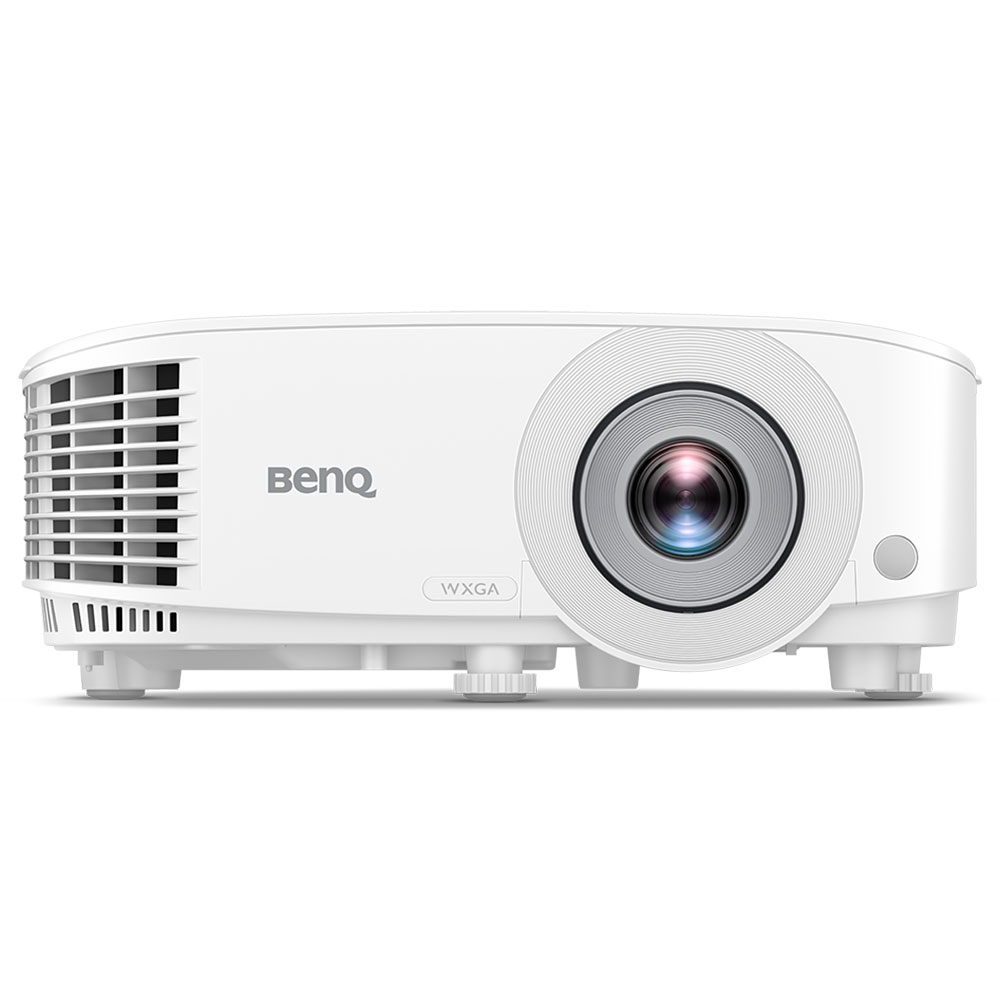
Check the product pages. The H96 MAX HY320 is rated at 230 ANSI lm, the H96 MAX HY300A at 100 lm with no ANSI label, and the office BenQ MW560 at 4000 lm. That is a 17–40x difference, and you see it on the wall in the first second.
To turn lumens into something meaningful, there is a simple estimate for a white wall: brightness in nits ≈ lumens ÷ (3.14 × image area in m²). A 100-inch 16:9 image is about 2.2 × 1.25 m, or 2.75 m². 230 lm gives roughly 27 nits on it, 4000 lm roughly 460 nits. For reference, the cinema target is about 48 nits in full darkness, and an ordinary TV puts out 250–500 nits. So a 100–230 lm mini projector is better stretched to 60–80 inches, not to the advertised 3.8 m diagonal.
How much light your room needs
- Up to 300 ANSI lm: full darkness only, blackout curtains, 60–80 inch diagonal. This is mini projector territory.
- 1500–2500 ANSI lm: a home cinema in a darkened room at 100 inches and up, evening viewing with dimmed lights.
- 3000–4000 ANSI lm: a living room with some light, a meeting room, a classroom. Office DLP models from BenQ sit here.
- 4500 ANSI lm and up: large halls and rooms with uncurtained windows.
Light-coloured walls and ceilings "eat" contrast: light bounces off them back onto the screen and black turns grey. In a room with white walls even 3000 lm will look worse than 1500 lm in a dark one. The check is simple: put up a black frame with white text and see whether you can read it from the sofa under your usual lighting.
Native resolution vs. "4K support"
"Supports 4K" in a cheap projector's description almost always means it accepts a 3840×2160 signal and squeezes it down to its own panel. Only native resolution matters, that is, the number of physical pixels. The HY300A has 1280×720, the HY320 1920×1080, and the BenQ MW560 1280×800 in 16:10, which suits laptop presentations.
At 80 inches the difference between 720p and 1080p is visible from 2–3 m: on 720p you see the pixel grid and blurry subtitles. For spreadsheets and small slide text, 720p is plainly not enough. How to check on delivery: open a page with small text in the projector's browser, or a test image with one-pixel lines. If the lines merge into a grey band, the panel is lower-resolution than the input signal.
DLP or LCD: the real-life difference
Nearly all mini projectors under 10,000 UAH use a single LCD panel with an LED behind it. The design is cheap and quiet but has two weak spots: low contrast (the HY series lists 1500:1 and 2000:1) and an unsealed optical path. Dust inside eventually shows up as dark spots on the image, and that is one of the typical reasons for warranty claims. Keep the projector in a case when it's not in use, and don't stand it on a deep-pile rug.
DLP uses a micromirror chip and a colour wheel; the optics are better sealed and contrast is higher: 20000:1 claimed for the MW560, 10000:1 for the TH671ST. The downside: some people see the "rainbow effect", colour flashes in high-contrast scenes when you move your eyes quickly. If you're one of them, see a DLP in person before buying. 3LCD projectors with three panels are a separate class: no rainbow, but a different price bracket.
Throw distance and short-throw models
Throw ratio tells you how far the projector has to stand: distance to the screen divided by image width. For a standard 1.5:1 model, a 100-inch screen (2.2 m wide) needs about 3.3 m from lens to wall. In a small room there's simply nowhere to find that distance, and people walk between the projector and the screen.
The short-throw BenQ TH671ST, per its description, gives 100 inches from 1.5 m and 150 inches from 2.3 m. The H96 MAX mini projectors also carry a "short-throw" tag on their pages, but the HY300A description gives a placement distance of 1.2 to 4 m. So work out the diagonal from the real distance to your wall and confirm it on the product page or with a consultant, rather than trusting the tag.
Noise, keystone and built-in Android
Every projector is cooled by a fan. Cheap models rarely state noise in decibels, and in quiet film scenes the hum is clearly audible from a metre away. If the projector sits on a shelf by your head, that annoys more than lower brightness. Check it on pickup at the Nova Poshta branch: run it for 10–15 minutes until the fan reaches working speed.
Automatic keystone correction on the HY300A and HY320 is handy, but it is digital: the picture is squeezed in software and some pixels simply go unused. At a 20–30° tilt, 720p effectively becomes an even lower resolution and text at the edges gets jagged. It's better to place the projector square to the centre of the screen and leave correction for a few degrees. The MW560 has ±40° vertical correction, but the same rule applies.
Built-in Android (9.0 on the HY300A, 11.0 on the HY320) gives you YouTube and a browser with no extra devices. However, such firmware is usually not certified by streaming services, so some apps may not install or may run at reduced quality. If those apps matter to you, budget for a separate TV stick on HDMI.
What a 2,400–5,300 UAH mini projector really gives you compared with a BenQ
| Parameter | H96 MAX HY300A | H96 MAX HY320 | BenQ MW560 | BenQ TH671ST |
|---|---|---|---|---|
| Approximate price | about 2,400 UAH | about 5,300 UAH | about 18,900 UAH | about 44,000 UAH |
| Technology | LCD, LED | LCD, LED | DLP, lamp | DLP, lamp |
| Brightness | 100 lm | 230 ANSI lm | 4000 lm | 3000 ANSI lm |
| Native resolution | 1280×720 | 1920×1080 | 1280×800 | 1920×1080 |
| Claimed contrast | 1500:1 | 2000:1 | 20000:1 | 10000:1 |
| Weight | 0.6 kg | 0.7 kg | 2.3 kg | 2.7 kg |
| Light source life | 50,000 h | 30,000 h | 6000–15,000 h | 4000–15,000 h |
| Video inputs | 1 HDMI | 1 HDMI | 2 HDMI, 2 D-sub | 2 HDMI, 2 D-sub |
| Warranty | 12 months | 12 months | 36 months | 36 months |
A 2,400–5,300 UAH mini projector means evening films in a dark bedroom at 60–80 inches, cartoons on the ceiling for the kids, viewing at the dacha. It's light (0.6–0.7 kg), has Wi-Fi and Bluetooth, and never needs a lamp change. What it won't give you: readable presentations with the lights on, deep blacks, or a large diagonal without brightness collapsing.
The BenQ MW560, at about 18,900 UAH, does what a mini projector can't: it shows slides in a lit meeting room on a screen up to 7.6 m diagonal, has two HDMI and two D-sub inputs for older laptops, plus RS-232 for control in a hall. You pay with 2.3 kg of weight, a lamp you will eventually replace (6000 h in normal mode, up to 15,000 h in LampSave), and no smart features. It will show films in a darkened room too, but 1280×800 on a large diagonal is not Full HD.
When a mini projector is not worth buying
If you want to replace a TV for everyday daytime viewing, a 100–230 lm mini projector will disappoint: with the curtains open the picture washes out almost completely. For that money a small TV is the better buy, and projectors are worth considering from 1500 ANSI lm. Same with the office: 230 lm is not enough for client presentations in a room with windows. Conversely, if you need a projector a few times a month for kids' films in the dark, there's no point overpaying for a BenQ; the Full HD HY320 will do.
Running a projector from a power station during outages
During power outages a projector with a power station often stands in for the TV. Power draw isn't listed on these models' pages, so before buying a station, check the label on the power adapter or measure with a wattmeter. As a rough guide, LED mini projectors draw tens of watts, lamp-based office models several hundred.
The maths is simple: station capacity in Wh × 0.85 (inverter losses) ÷ draw in W. A 500 Wh station will run a 50 W projector for about 8 hours, but a 250–300 W lamp model for only 1.4–1.7 hours. Lamp projectors have one more catch: after switch-off the fan has to cool the lamp, so don't yank the cord straight away and don't let the station run flat mid-show. Cutting power to a hot lamp shortens its life, and the station's inverter should output a pure sine wave.
Models with filters for brightness, resolution and light source are collected in the Projectors section. Before ordering, measure the distance from where the projector will stand to the wall and work out the diagonal and the brightness in nits with the formula above: that weeds out most bad purchases before you pay.


Comments