



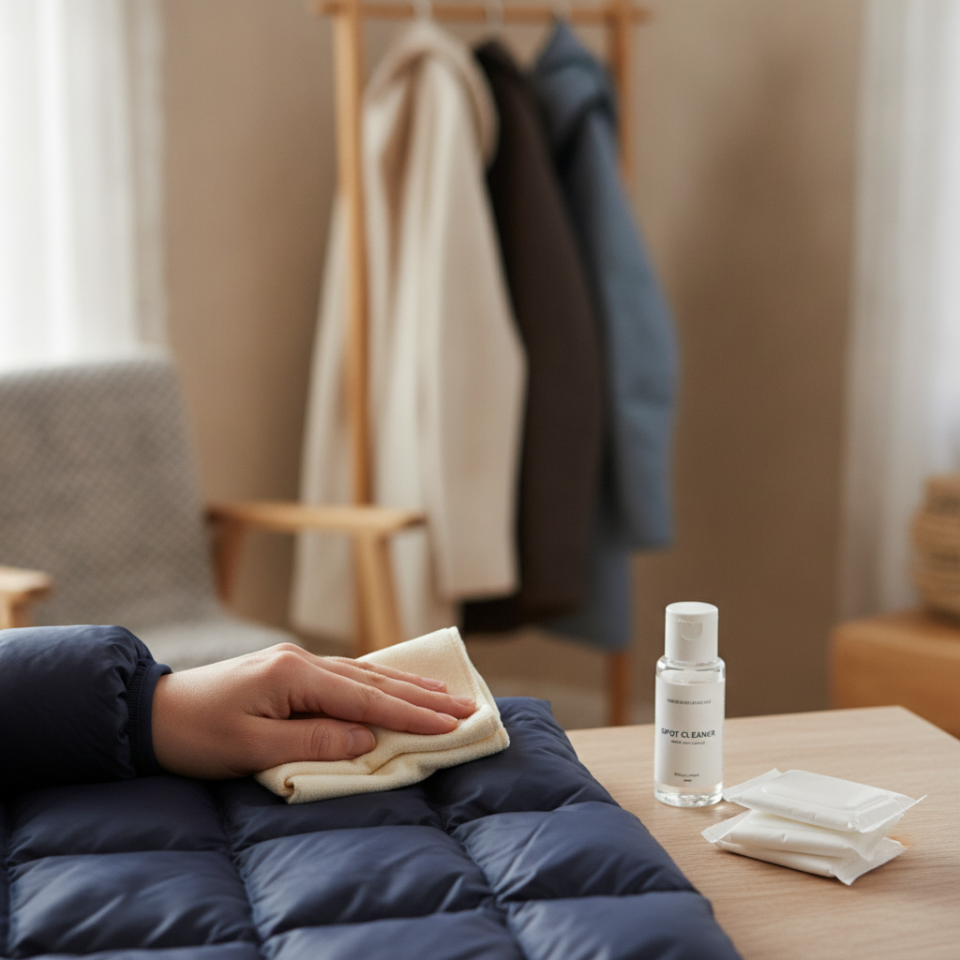
We wear a winter down jacket every day for several months straight, so stains on it are almost inevitable: grease from food, grime from the minibus, white streaks from snow and road salt, foundation on the collar and hood. Many people take the jacket straight to the dry cleaner, yet most of these marks can be removed at home in 10-15 minutes. The key is knowing what down and a water-repellent finish can handle, and what will ruin the jacket faster than any stain.
Why you can't clean a down jacket like a cotton T-shirt
The shell of most down jackets and jackets with synthetic or hollow-fibre fill is thin polyester or nylon treated with DWR (durable water repellent). It makes water bead up and roll off, and for the same reason ordinary soap or washing powder barely soaks into the fabric. Powder also rinses out of dense down poorly and leaves whitish streaks.
What does the most damage:
- Fabric softener. It coats the fibres, kills the water repellency and glues the down into clumps.
- Chlorine bleach, acetone, petrol, solvents. They can dissolve the finish, the membrane or the glue on taped seams.
- Water hotter than 30-40 °C and an iron. Synthetic fabric goes shiny and warps, and heat sets a protein stain for good.
- Hard rubbing. Thin fabric goes fuzzy and the stain spreads wider.
Safe options: a liquid detergent for down or delicates, a drop of dish soap for grease, a weak vinegar solution for salt, micellar water for make-up. Always test any product on an inside seam or under a pocket flap first.
Which stain, and what to tackle it with
| Stain type | What to do | What to avoid |
|---|---|---|
| Grease from food or hands | A drop of dish soap, work it in with a finger, after 5-10 min lift it off with a damp sponge | Hot water, salt or chalk on thin fabric |
| Salt streaks | Let it dry, brush it off, wipe with 1 tbsp of vinegar in 0.5 l of warm water | Rubbing wet salt before it has dried |
| Street dirt | Let it dry, shake it off, then a soapy sponge | Cleaning fresh wet mud: it just smears |
| Foundation on the collar | A cotton pad with micellar water, dabbing motions | Alcohol-based lotions on coloured fabric |
| Sweat and deodorant on the lining | Liquid laundry detergent, leave for 10-15 min, rinse off | Chlorine and peroxide on a coloured lining |
A word on "snow stains". Usually it isn't the snow itself but dissolved dirt that the water has pulled to the edge of the wet patch. A ring after a botched spot clean forms the same way. You get rid of it by lightly dampening a wider area and blending the edge from the centre outwards, or with a full wash.
Stain-removing wipes: for a fresh stain before it sets
When the stain is fresh and a sink is far away, the fastest fix is a pre-moistened wipe. Kept in a bag or the car glovebox, it saves the day with coffee or sauce before the grease works its way into the fibres. An old stain that has been ground in with dirt a few times usually won't come out with a wipe.
We stock SunnyOct cleaning wipes for outerwear and down jackets: 12 per pack, each 140 x 180 mm, roughly 70 UAH. The manufacturer says they suit down jackets, cotton, wool and polyester. The description doesn't list the exact formula, so on a light-coloured or expensive jacket wipe a hidden spot first and let it dry.

Work from the edge of the stain towards the centre, dab rather than rub, and switch to a fresh wipe once it gets dirty. Other home care products, from brushes to laundry detergents, are in the Clothing care products section.
Spot cleaning or a full wash
Spot cleaning is for one to three fresh stains. If the cuffs, collar and pocket edges have all gone greasy, the jacket smells, or the down has visibly flattened, washing the whole thing is the right call: ten spot cleans will leave ten rings.
How to clean a stain without soaking the down
- Brush off dry dirt and salt.
- Put a folded towel inside, under the stain, so the moisture goes into it.
- Apply the cleaner with a sponge that is barely damp and well wrung out.
- Dab from the edge towards the centre and wait 5-10 minutes.
- Wipe off the residue with a clean damp sponge and blot with a dry towel.
- Dry on a hanger at room temperature.
The less water gets inside, the better. Wet down in a baffle takes a day or longer to dry, and brown marks can come through: natural down that gets soaked releases tannins onto light fabric.
If you wash the whole jacket
Check the care label. If washing is allowed, close all zips and Velcro, turn the jacket inside out, add a liquid down detergent, pick the "Down" or "Delicates" programme at 30 °C, and spin at no more than 600-800 rpm. Add one extra rinse: leftover detergent clumps the down too. Put 2-3 tennis balls or dryer balls in the drum; they break up the clumps.
Drying so the down doesn't clump
Drying is where down jackets get ruined most often. Don't put the jacket on a radiator, next to a fan heater or in direct sun: the fabric overheats, and the down dries on the surface while staying damp deep in the baffles.
- Dry on a wide hanger or flat at 20-25 °C.
- Every 1-2 hours, shake the jacket and break up clumps with your fingers.
- Drying fully takes 2-3 days; in a cold flat during power outages it can take longer.
- Use a tumble dryer only if the label allows it, on low heat and with balls.
If the dried jacket smells damp, the down inside is still wet. Finish drying it, or it will develop a musty smell that only another wash will get rid of.
DWR often weakens after washing: water no longer beads up but soaks into the fabric in dark patches. Gentle heat in a tumble dryer on low, if allowed, partly restores it, and if that doesn't help, you need a reproofing spray for outerwear.
A spot-cleaner vacuum for a jacket: when it makes sense
A spot-cleaner vacuum does the same job as a sponge but sucks the dirty water out straight away. For a down jacket that is a plus: the moisture barely reaches the fill. Two options from our catalogue:
- Adler AD 7088: 400 W, 11.5 kPa suction, 1.5 l clean-water tank and 0.8 l dirty-water tank, 84 dB, 5 m cord, shoe brush included. Roughly 5200 UAH.
- AIWA Sumisui SPOT CLEANER: 600 W, 10 kPa, two 1.5 l tanks, 4 m cord, rubber and silicone brushes. Roughly 6600 UAH.
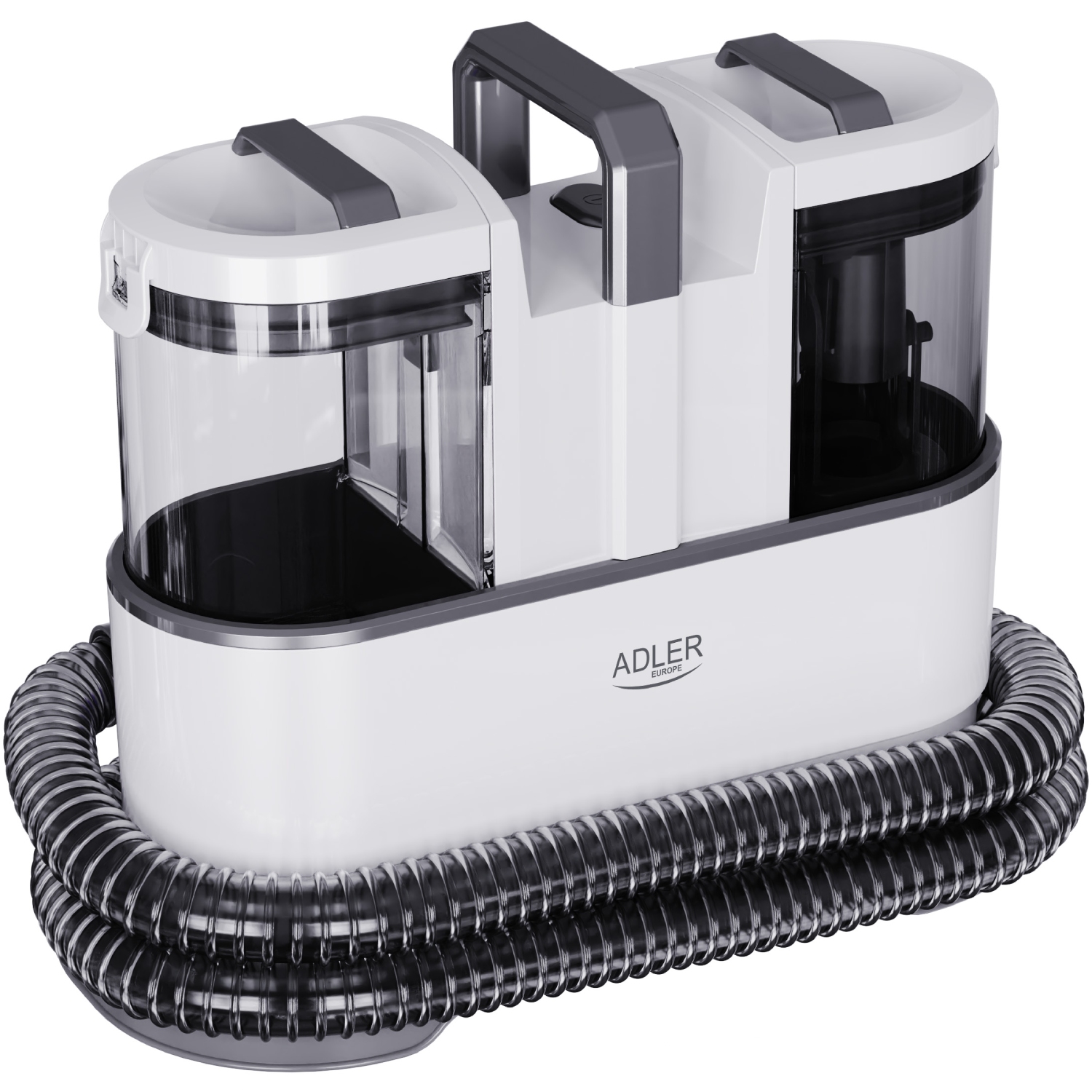
Neither model has power adjustment. On thin fabric, work in short passes and don't run the nozzle along stitched seams: 10-11.5 kPa of suction can pull down fluff through the needle holes.
To be honest, buying a 400-600 W machine for 5,000-7,000 UAH just for one down jacket makes no sense. A pack of wipes and a sponge will do the same job for next to nothing. A spot cleaner pays off if you have a light-coloured sofa, carpets, a child seat in the car or pets, and the jackets come as a bonus.
When to take it to the dry cleaner straight away
- The label says dry clean only (a circle with a P or F) or shows a crossed-out washtub.
- There is leather, suede or natural fur that doesn't come off.
- The stain is ink, paint, motor oil, tar or glue.
- The stain has already been ironed or blow-dried and has set.
- It's an expensive jacket with a membrane or laminated shell, and the label gives no clear instructions.
At the dry cleaner, ask for wet cleaning for down and check whether they fluff the fill while drying. If it's just an ordinary grease stain on polyester, try a drop of dish soap and a sponge first: at worst you lose nothing, and you can still take the jacket to the dry cleaner afterwards, as long as you don't iron it or dry it on a radiator.


Comments