



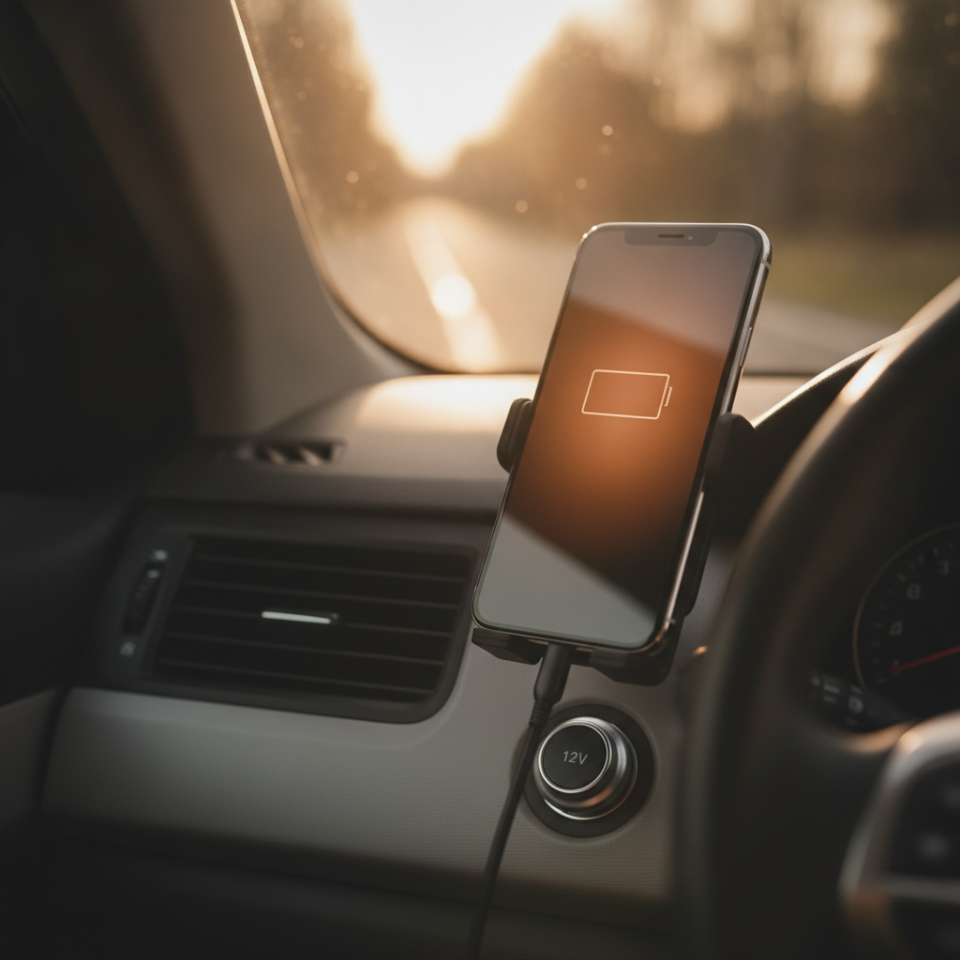
A phone drains in the car for three reasons, and they often stack on top of each other: the car charger delivers less current than the screen with navigation consumes; the phone heats up in the sun and cuts its own charging; the cable or the socket can't deliver the needed current. Below, in order: how to tell them apart, check it yourself and fix it.
How much a phone actually burns on the road
Navigation with a bright screen, mobile internet in a weak-signal area, Bluetooth to the head unit and GPS all running at once can draw 5-8 W. That is roughly 1.3-2 A at 5 V. An old 5 V / 1 A (5 W) car charger simply can't keep up with that consumption: the phone is formally "charging", but the percentage slowly falls.
This is what people most often bring to us in the chat: "I put it on charge, and after an hour of driving it's down 10%". In 8 cases out of 10 the problem is a 100-150 UAH charger that puts out 5 W, or a cable that came with a cheap headset.
Why a phone heats up in the car and how that steals charge
In summer the cabin in direct sun heats up to 60-70 °C, and the dashboard and glass are even hotter. A phone on a mount near the windshield gets the sun straight onto its screen. When the internal temperature approaches 40-45 °C, the system slows charging down or stops it completely. The charging icon may still show on the screen while the actual current is close to zero.
An extra problem is wireless charging in the mount. Its efficiency is around 60-75%, and the rest goes into heat, released right under the phone's body. In hot weather it works worse than a wire. If you see a temperature warning in summer, switch to a cable.
In winter the problem is the opposite: at minus 10-15 °C a lithium-ion battery temporarily loses a noticeable share of its capacity and accepts charge more slowly. Warm up the cabin and don't leave the phone in a cold car overnight.
Car charger: what to look at in the specs
The catalog has a separate category for car chargers. Go by a few parameters, not by nice packaging:
- Power per port. To run navigation and charge at the same time you need at least 18 W per port. For modern smartphones with fast charging support (PD or QC), 20-30 W is comfortable.
- Total power across several ports. If the manufacturer writes "45 W", that is often the combined figure for two ports. When two devices are connected at once the power is split, and each gets 20+ W at best.
- Protocols. USB PD for iPhone and most Android phones, QC 3.0 for older Android. If the protocol doesn't match, the phone will get the basic 5 V / 1-2 A.
- Protections. Against overheating, short circuit and overvoltage. A car's electrical system is unstable, especially at the moment the engine starts: the voltage floats between 12 and 14.5 V.
A typical buyer mistake: picking a metal-bodied charger for 150-250 UAH with no declared protocol. It puts out 5 V / 2.4 A (12 W) and gets hot, but gives no fast charging. A decent PD option at 20-30 W costs roughly 400-900 UAH depending on the brand.
The cable matters as much as the charger
A thin cable with thin conductors has high resistance. Voltage drops across it, charging falls from 18 W to 7-8 W, and on cables longer than a meter it shows up even more. The cables bundled with smartphones costing 3000 UAH or less are often rated for only 5-10 W.
What to check when buying: declared PD or 3 A support, length no more than 1 m for in-car charging, and cable thickness (a thin "noodle" cord is almost always 5 W only). You can pick charging and data sync cables in a separate section.
How to find the weak link in 5 minutes
- Buy a USB power meter (roughly 250-500 UAH) or borrow one from a friend. Plug it in between the car charger and the cable.
- Connect the phone with navigation on and the screen at medium brightness. Watch the power in watts: it should be 15 W or more for a phone with PD.
- If it shows 5-8 W, try a different cable. If that doesn't help, replace the charger.
- If the power is normal at first and then drops after 10-15 minutes, the phone is overheating. The problem is the mounting position and the sun, not the equipment.
- Check the phone's body temperature by touch: above 40 °C it feels clearly warm and unpleasant. That is the signal to take it off the mount or move it out of the sun.
Mounts and cooling: what really helps
Place the phone not under the windshield but closer to the air conditioner vent. In hot weather the stream of cool air lowers the body temperature by 8-12 °C, and charging isn't throttled. Car mounts that clip onto the vent suit this, unlike suction cups on the glass. When choosing, look at how well it holds the phone on bumpy roads: a weak spring causes damaging vibrations for a camera with optical stabilization.
You can also get the phone out of direct sun with a sunshade for the windshield. It reduces heating of the dashboard and the phone.
A power bank as an alternative
If the cigarette lighter socket is weak and the car charger won't deliver the power, there is a convenient way out: a 10,000-20,000 mAh power bank connected to the phone. It doesn't depend on the car's electrical system. The downsides: it heats up too, it can't handle cabin heat above 45-50 °C, and it takes up space. Don't keep it in the glove box in summer: lithium batteries don't like prolonged overheating, and their lifespan shortens.
Different external batteries (Power Banks) differ in maximum output per port. To power a phone running navigation you need 18 W and above, otherwise the power bank works like a drip feed rather than a charger.
When you don't need to change anything
If your drive is 15-20 minutes across town, you rarely need navigation, and the phone is charged above 60% at the start, any 5 W charger will do. An extra 500-1000 UAH for a PD charger won't pay off. The same goes for an old phone with a worn battery (3-4 years of active use): a new charger won't restore the capacity. Only a battery replacement at a service center will help there, usually 600-1500 UAH depending on the model.
Frequently asked questions
Why does the phone say "charging" while the percentage drops?
The charger delivers less than the phone consumes. This is normal for 5 W chargers with navigation on and a bright screen. The fix: a PD or QC charger of 18 W or more and a good cable.
Does fast charging in the car harm the phone's battery?
Fast charging itself does less harm than heat. If the phone doesn't overheat above 40 °C, the battery's lifespan suffers minimally. Constant overheating in the sun wears it out much faster.
Can I charge from the head unit's USB port?
Usually not, if you need more than just topping up. The USB ports on head units are often limited to 0.5-1 A and meant for data transfer. For charging you need a separate cigarette lighter charger.
Wireless charging in the car: yes or no?
It's convenient for short trips and moderate temperatures. In hot weather and on long routes with navigation, a wire is more reliable: less heat and more stable power.
If you've checked with a power meter and the charger delivers 15-20 W, the cable is short and good quality, and the phone still drains and heats up, the cause is in the phone itself: a worn battery or aggressive background apps. There's no point buying new accessories in that case; first check the battery condition in the settings or at a service center.
Comments