



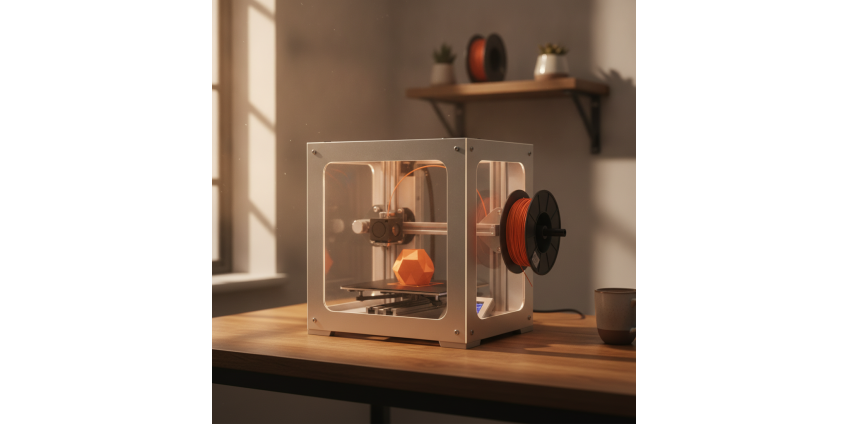
How to Choose a 3D Printer for Home Use in 2026: A Beginner's Guide
3D printing has stopped being an exotic tool for engineers and designers — today a home 3D printer can be found in a kitchen, a kid's room, or an amateur craftsman's garage. In 2026, the technology has become more accessible, simpler, and significantly cheaper, so now is the perfect time to figure out how to choose your first 3D printer, which printing technology to pick, and which filament is best for getting started.
Why FDM Technology Is the Best Choice for Home Use
Among all types of 3D printing, FDM (Fused Deposition Modeling) remains the most popular choice for home use. The working principle is simple: a plastic filament melts in the extruder and is deposited layer by layer, forming a three-dimensional model.
Advantages of FDM for beginners:
- Affordable price for both the printers themselves and consumable materials
- Easy maintenance and repair
- A wide selection of filaments to suit any taste and budget
- Safety — no toxic resins or ultraviolet lasers, unlike SLA printing
SLA/DLP printers offer higher detail, but they require working with liquid resins that need hand protection, room ventilation, and additional post-processing. For family use, teaching kids, or your first experiments, FDM remains the optimal starting point.
What to Look for When Choosing a 3D Printer
Build Volume
A standard print area of 220x220x250 mm is suitable for most home tasks — from figurines to functional parts. If you plan to print large objects (such as decor elements or enclosures), it's worth looking at models with a larger build chamber.
Automatic Bed Leveling
This is probably the most important feature for a beginner. Manual bed leveling is the main cause of failed first prints. Printers with auto bed leveling make life much easier and minimize failed first attempts.
Enclosed vs. Open Frame
Open-frame printers are cheaper and easier to maintain, and they work well for printing PLA. Enclosed chambers stabilize the internal temperature, which is critical if you plan to print ABS or other demanding materials.
Print Speed and Frame Rigidity
In 2026, more and more budget models feature CoreXY kinematics and rigid frames, allowing for faster printing without sacrificing quality. For a beginner, speed isn't critical, but it's nice when a model prints in 3 hours instead of 8.
PLA or PETG: Which Filament to Choose for Your First Models
Choosing a material is one of the main questions a beginner faces right after buying a printer.
PLA — The Best Choice for Getting Started
PLA (polylactic acid) is a biodegradable plastic made from corn starch. It's the easiest material to work with:
- Low printing temperature (190-220°C), no heated bed required
- Barely warps, adheres easily to the print surface
- Minimal odor during printing
- A wide range of colors and even special effects (silk, wood, metallic)
The downside of PLA is its brittleness and low heat resistance: printed objects can deform at temperatures as low as 55-60°C, so you shouldn't leave them, for example, in a car in the sun.
A great example of what can be made with PLA is
₴5,999 грн. ₴9,499 грн.
₴69 грн. ₴109 грн.
₴549 грн. ₴699 грн.
₴76,230 грн. ₴101,768 грн.
Products related to this post
Comments
![Collectible figure Labubu Toy [FDM printing]](https://gadgetguys.com.ua/image/cache/catalog/easyphoto/5906/grashka-ruhliva-red-panda-chervona-panda-fdm-druk-1-266x266.png "Collectible figure Labubu Toy [FDM printing]")